Jenn-Air’s microwave lineup ranges from straightforward built-in units to the combination speed-cook ovens in its Culinary Center series, which pack microwave, convection, and broil functions into a single cavity. That added complexity is what makes some Jenn-Air microwaves more capable than a standard countertop unit, and also what makes diagnosis less straightforward when something goes wrong.
Understanding the Jenn-Air Microwaves
Below, our specialists break down everything you need to know about the Jenn-Air Microwaves.
The microwave lineup
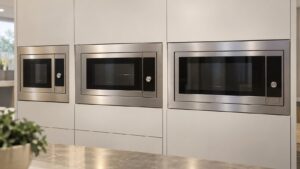
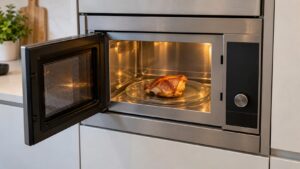
Standard built-in microwaves in the RISE, NOIR, and Euro-Style lines focus on straightforward reheating and defrosting with sensor-assisted auto-cook programs. The Culinary Center series steps up to combination cooking, pairing microwave energy with convection heat and broil elements so the same cavity can bake, roast, or crisp in addition to microwaving — functioning as a genuine second oven in a compact footprint. For kitchens without room for a full double wall oven, a Culinary Center unit is often the practical way to add real baking capacity without giving up cabinet space elsewhere. Trim kits and finish options are designed to be visually consistent with matching wall ovens from the same design line, so a stacked oven-and-microwave installation reads as a single cohesive appliance wall rather than two mismatched units.
- Standard built-in microwaves with sensor auto-cook
- Culinary Center combination microwave-convection-broil ovens
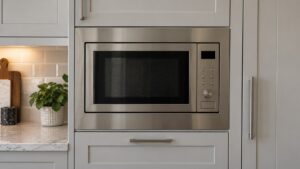
- Trim-kit compatible designs for above or below wall-oven placement
- Finish options across RISE, NOIR, and Euro-Style lines
Signature technologies
Sensor cooking uses a humidity sensor inside the cavity to detect steam released by food and automatically stop or adjust cooking, which is more precise than fixed time settings but depends on that sensor staying accurate over years of use. Culinary Center combination cooking layers a convection fan and heating element into the same cavity as the magnetron, with control logic that switches between modes or blends them, which is a meaningfully more complex system than a microwave-only unit.
Trim-kit compatible design lets a built-in microwave install directly above or below a matching wall oven, sharing a cohesive front panel appearance, but it also means the microwave’s ventilation and electrical connections have to coexist in a tighter footprint than a standalone countertop unit would need.
Common problems and reliability
Sensor drift is the most common long-term issue, gradually causing auto-cook programs to run too long or stop too early well before the microwave shows any other symptoms. On combination units, the convection fan or heating element can fail independently of the microwave function, so a unit might still microwave normally while failing to bake or broil. Door switches and keypads are typical wear items on any high-use built-in microwave. Our error code guide covers the specific codes tied to each problem, and microwave repair is available for diagnosis beyond a simple reset.
Magnetron failures are less frequent than electronic problems but tend to be terminal for that component, since a magnetron doesn’t degrade gradually the way a sensor does — a unit either heats normally or it doesn’t. Because these are high-voltage components, any diagnosis or repair involving the magnetron circuit should always be handled by a trained technician rather than attempted as a DIY project. Combination units generally see more component-level wear over time simply because they have more moving and heating parts working together than a microwave-only unit ever needs to coordinate, which is worth keeping in mind when comparing the two formats during a kitchen build or remodel, especially when weighing long-term maintenance against the added flexibility a combination unit provides.
Maintenance tips
Keep the interior cavity clean, since baked-on food residue can interfere with the humidity sensor’s readings over time. Avoid running the microwave empty, which stresses the magnetron unnecessarily. On Culinary Center units, clean the convection fan vents periodically to keep airflow consistent for baking and roasting modes. Check the door seal and hinge alignment every so often, since a door that isn’t closing perfectly flush can prevent the unit from starting at all as a built-in safety measure. Jenn-Air’s manufacturer site at jennair.com has model-specific specs, and our models reference tracks units our technicians regularly service.