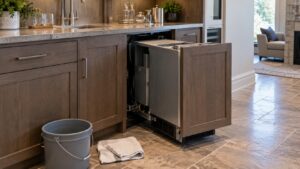
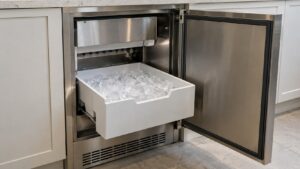
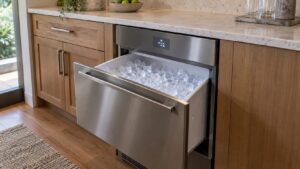
This overview covers Jenn-Air Ice Makers — the lineup, signature technologies, common problems, and upkeep.
Jenn-Air’s ice makers are designed to disappear into cabinetry — under a bar counter, in an outdoor kitchen, or beside a column refrigerator — while producing a steady supply of ice on demand. Because they’re a fixed plumbing installation rather than a simple appliance, their reliability depends as much on the water and drain lines feeding them as on the unit itself.
Understanding the Jenn-Air Ice Makers
Below, our specialists break down everything you need to know about the Jenn-Air Ice Makers.
The ice maker lineup
Jenn-Air offers built-in and under-counter ice makers across the RISE and NOIR design lines, including clear-ice models that use a slower, more controlled freeze process to produce dense, restaurant-style clear cubes rather than the cloudier cubes standard freezer ice makers produce. Capacity and cube style vary by model, but all built-in units share the same basic dependency on a dedicated water supply line and a drain connection. Because they’re a fixed installation rather than a portable appliance, most kitchen and bar designs plan the plumbing and electrical rough-in for an ice maker well before the cabinetry itself is finalized, which makes it worth confirming water and drain access during the design phase rather than after cabinets are already installed.
- Under-counter and built-in installation options
- Clear-ice models for dense, slow-frozen cubes
- Finish options matching RISE and NOIR design lines
- Storage bins sized for continuous, on-demand production
Signature technologies
Clear-ice production relies on a controlled, gradual freeze that pushes trapped air and minerals out of the cube as it forms, which is why the process takes noticeably longer than a standard icemaker cycle and depends heavily on accurate thermistor readings. Built-in units also run periodic cleaning cycles to clear mineral scale from water lines, since scale buildup is one of the fastest ways ice quality and output degrade over time.
Because these are fixed plumbing appliances, installation location matters more than with most kitchen appliances — an under-counter unit near a heat source, or an outdoor bar installation exposed to summer heat, will naturally cycle harder than one in a climate-controlled kitchen.
Common problems and reliability
Water flow and pressure issues cause more ice maker service calls than any internal component failure — a shutoff valve that’s only partially open, or a supply line with a slow kink, can throttle ice production long before anything inside the unit is actually broken. Drain-side problems are the next most common, since these units cycle water in and out constantly and a partial clog compounds over weeks. Thermistor failures affect clear-ice models more visibly, since that process is sensitive to precise temperature control. Our error code guide covers the codes tied to each of these problems, and ice maker repair is available when the water path checks out fine and the problem is internal.
Outdoor and bar installations also see more ambient-temperature-related problems than kitchen units, simply because the surrounding air temperature swings more throughout the year and the unit has to work harder to compensate during warmer months. Because these units run continuously rather than cycling on and off like a refrigerator compressor, component wear tends to accumulate steadily over the year rather than concentrating around seasonal peaks the way outdoor equipment sometimes does. Cube quality is often the earliest indicator of a developing problem, so a gradual change in ice shape or clarity is worth noting even before output actually drops and worth mentioning to a technician when you book service.
Maintenance tips
Run the manufacturer-recommended cleaning cycle on schedule, especially in hard-water areas, since mineral scale is the leading cause of reduced ice output. Check the shutoff valve behind the unit periodically to confirm it’s fully open, since a partially closed valve is an easy thing to overlook. Keep the drain line clear of kinks during any nearby cabinetry work. If the unit is installed outdoors or in an uninsulated bar area, confirm it’s rated for that ambient range before assuming a problem when output drops during the hottest months. Jenn-Air’s manufacturer site at jennair.com lists model-specific water and drain requirements, and our models page tracks units our technicians regularly service.