This overview covers Jenn-Air Ovens — the lineup, signature technologies, common problems, and upkeep.
Jenn-Air’s wall oven lineup is built around consistent, professional-grade baking, and the technology that sets its double ovens apart is V2 Vertical Dual-Fan Convection — a system most competing brands don’t offer in a comparable form. Understanding how it works clarifies why some baking complaints are sensor issues and others are mechanical.
Understanding the Jenn-Air Ovens
Below, our specialists break down everything you need to know about the Jenn-Air Ovens.
The wall oven lineup
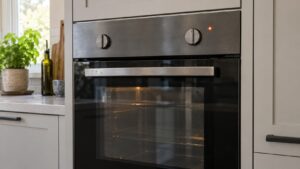
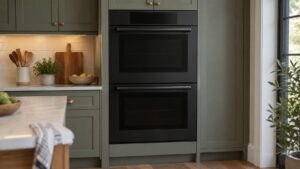
Jenn-Air offers single and double wall ovens across the RISE, NOIR, Euro-Style, and Pro-Style design lines, plus combination units in the Culinary Center series that add microwave and speed-cook functions to a standard bake cavity. Double ovens give each cavity independent temperature control, letting one run a slow roast while the other handles a quick reheat. Single ovens remain a common choice for smaller kitchens or as a companion to a separate cooktop and microwave, while double ovens are typically specified in kitchens built around serious entertaining or large-family cooking schedules.
- Single and double wall oven configurations
- V2 Vertical Dual-Fan Convection on double-oven models
- Culinary Center combination microwave-convection ovens
- Self-clean cycles with automatic door locking
Signature technologies
V2 Vertical Dual-Fan Convection uses two fans mounted vertically along the back wall of the cavity rather than a single rear fan, which is designed to circulate heat more evenly across multiple racks — a genuine advantage when baking on two racks simultaneously, since a single-fan convection oven tends to favor whichever rack sits closer to the fan. Self-clean cycles run the cavity at extremely high temperatures and rely on an electronic door lock to keep the door sealed until the cycle finishes and the interior cools to a safe range.
Culinary Center combination ovens extend this further by adding microwave energy into a convection cavity, letting a single unit switch between true convection baking and speed-cook combination modes. That flexibility comes from more complex control logic than a standard single-function oven needs to manage. Electronic door locks tied to the self-clean cycle are engineered to fail safe, meaning the lock is designed to stay engaged rather than release accidentally during a high-heat cycle, which is exactly why a stuck lock requires a technician rather than a simple manual override. Culinary Center ovens extend the same fail-safe philosophy to their combination modes, defaulting to a safe stopped state rather than an undefined blended mode if the control logic ever detects a conflicting signal from its sensors, which is by design rather than a malfunction in itself, and understanding that distinction saves an unnecessary service call more often than you’d expect.
Common problems and reliability
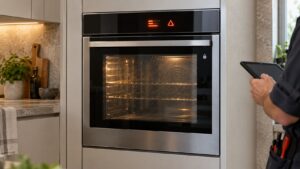
Temperature sensor drift is the most common issue across both single and double ovens, gradually skewing baking results before the oven throws any hard error code. On V2-equipped double ovens, an imbalance between the two convection fans is a distinctive failure mode that shows up as uneven browning between racks rather than a temperature problem across the whole cavity. Door lock motors see heavy use on ovens that self-clean regularly, and that’s where most lock-related service calls originate. Check our error code guide for what specific error codes mean, and book oven repair when a problem needs a technician.
Control board EEPROM corruption tends to follow power events rather than normal wear, which is why homes in areas prone to storms or grid fluctuations see a disproportionate share of this particular problem compared to routine mechanical wear.
Maintenance tips
Run self-clean cycles only as often as needed, since the extreme heat accelerates wear on the door lock motor and gasket. Keep the temperature sensor probe free of food debris, since buildup there can throw off readings. On double ovens, avoid blocking the vertical fan housings at the back of the cavity with oversized bakeware. Wipe down door gaskets periodically, since a compressed or torn gasket can let heat escape and force the oven to run longer than necessary to maintain temperature. Jenn-Air’s manufacturer site at jennair.com has model-specific specifications, and our models reference tracks units our technicians regularly service.