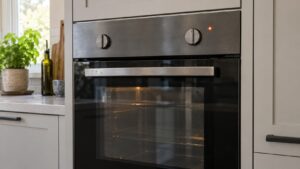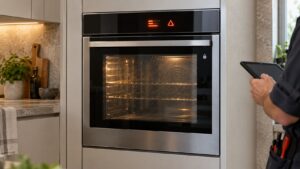
This guide explains the Jenn-Air Oven F3-E2 Error: what it means, what causes it, and how to resolve it safely.
This guide explains the Jenn-Air F3-E2 Error 2: what it means, what causes it, and how to resolve it safely.
Understanding the Jenn-Air Oven F3-E2 Error
Below, our specialists break down everything you need to know about the Jenn-Air Oven F3-E2 Error.
Understanding the Jenn-Air F3-E2 Error 2
Below, our specialists break down everything you need to know about the Jenn-Air F3-E2 Error 2.
What F3-E2 means on your Jenn-Air wall oven
If your wall oven display suddenly shows Jenn-Air F3-E2 error, the internal self-check has identified oven over-temperature. The F3-E2 error code on Jenn-Air wall ovens means the oven cavity has exceeded its maximum safe temperature. The underlying electronics on this control platform have been in service long enough that repair technicians see F3-E2 regularly on Jenn-Air wall ovens, which means diagnosis is usually quick once someone experienced is looking at it in person rather than over the phone.
From a usability standpoint, the control board has activated the over-temperature safety shutoff to prevent fire or appliance damage. A power cycle clears the error, but the underlying problem will cause the oven to overheat again. Homeowners sometimes assume F3-E2 means the entire wall oven needs replacing, but that’s rarely the case — these control systems are built with modular boards and sensors specifically so that a single failed part can be swapped without replacing the whole appliance.
Symptoms
Along with F3-E2, keep an eye out for these related behaviors on the wall oven, since they help confirm the diagnosis:
- The F3-E2 code shows on the wall oven’s display, sometimes with a beep sequence.
- Normal wall oven operation is interrupted or blocked while F3-E2 is present.
- Relay contacts remain closed when tested.
- Sensor resistance has drifted from specifications.
- Control board shows signs of heat damage.
Common causes
Working from the most to least frequent on a wall oven, here’s what typically triggers F3-E2:
- Stuck bake or broil relay — a relay on the control board has welded closed, keeping the heating element powered beyond the set temperature. Because this generally isn’t something an owner can safely repair without replacement parts and test equipment, it’s usually flagged for a professional from the start.
- Temperature sensor reading too low. In practice, a drifted sensor reads lower than actual, causing the control to overheat the oven before the safety limit triggers. Because this generally isn’t something an owner can safely repair without replacement parts and test equipment, it’s usually flagged for a professional from the start.
Troubleshooting steps you can try
Start from the top of this list and stop on the wall oven as soon as either F3-E2 clears or you reach a step marked as requiring tools you don’t have on hand.
- Disconnect power immediately. Turn off the circuit breaker for the oven. Do not use until repaired. An overheating built-in oven can damage surrounding cabinetry and is a fire hazard. This step is safe for most owners to try without any special equipment or electrical experience.
- Let oven cool with door closed. Allow the oven to cool completely before opening the door or inspecting. Built-in ovens retain heat longer than freestanding models due to cabinet insulation. This step is safe for most owners to try without any special equipment or electrical experience.
Should F3-E2 persist on the wall oven after these checks, the remaining possibilities all point toward a part swap rather than anything you can adjust or clean your way out of.
When to call a technician
Signs that this has moved past a DIY fix include: Relay contacts remain closed when tested; Sensor resistance has drifted from specifications; Control board shows signs of heat damage. When those conditions accompany F3-E2, the smart move is to book a technician rather than keep guessing. Getting an accurate diagnosis of F3-E2 up front also protects the rest of the wall oven — some of these failures, left unaddressed, can eventually stress neighboring components that weren’t part of the original problem.
A power cycle can clear the F3-E2 display temporarily, but that alone rarely fixes what triggered it in the first place on this wall oven. If you’d rather not open up the wall oven yourself, schedule a service visit and one of our specialist technicians will bring the right meters and parts knowledge to diagnose it properly. You can also browse other Jenn-Air error codes we’ve documented, or check jennair.com for model-specific service bulletins.