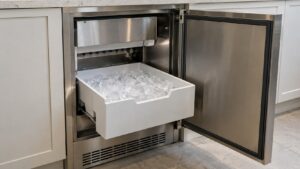
This guide explains the Jenn-Air Ice Maker E1 Error: what it means, what causes it, and how to resolve it safely.
This guide explains the Jenn-Air E1 Error 2: what it means, what causes it, and how to resolve it safely.
Understanding the Jenn-Air Ice Maker E1 Error
Below, our specialists break down everything you need to know about the Jenn-Air Ice Maker E1 Error.
Understanding the Jenn-Air E1 Error 2
Below, our specialists break down everything you need to know about the Jenn-Air E1 Error 2.
What E1 means on your Jenn-Air ice maker
A Jenn-Air E1 error points to the primary thermistor that the control board relies on to monitor internal temperature throughout the ice-making cycle. When this sensor drifts or fails, the timing and quality of ice production can suffer even though the compressor and other mechanical parts may be working perfectly fine — the system simply can’t tell accurately when conditions are right to complete each cycle.
Ice quality is often the best clue here, since a misreading sensor tends to produce visibly inconsistent cubes well before the unit stops making ice entirely.
Symptoms
- E1 shown on the display
- Ice cubes coming out undersized, cloudy, or inconsistent in shape
- Cycle times that seem longer or shorter than usual
- No apparent change in overall cooling or ice bin temperature
Common causes
- Failed thermistor — the sensor has drifted out of calibration or developed an open or short circuit.
- Sensor wiring issue — a break or poor connection between the sensor and the control board disrupts the signal.
Troubleshooting steps you can try
- Power cycle the unit. Unplug for five minutes, restart, and give it a couple of cycles to see whether ice quality improves — a temporary glitch may clear this way.
- Evaluate several ice batches. Run a few full cycles and inspect the resulting cubes for consistent size and clarity; steady, full-sized clear cubes suggest the sensor is functioning, while erratic results point back to E1 as a genuine hardware issue.
When to call a technician
A sensor testing outside its specified resistance range, a corroded connector, or visibly damaged wiring all call for replacement of the thermistor assembly. schedule a service visit if power cycling doesn’t restore consistent ice quality, since a technician can confirm the exact problem with proper test equipment rather than relying on trial and error. Related codes are at our full Jenn-Air error code library, and jennair.com has sensor part information.