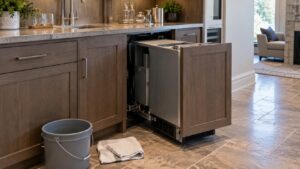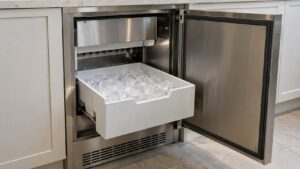
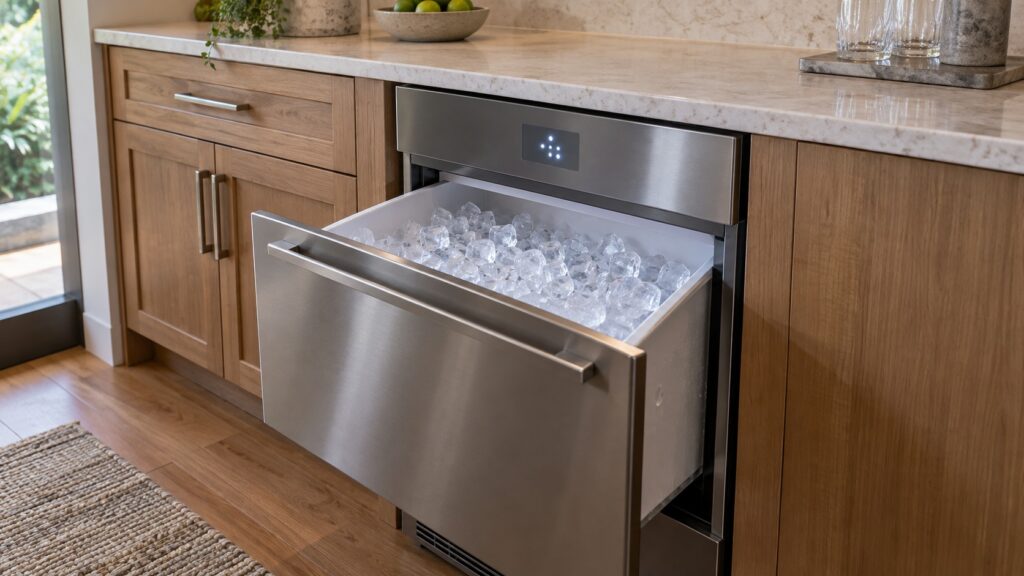
Three of the codes a Jenn-Air ice maker can show are not faults at all, and mistaking them for one is the single most common reason these units get an unnecessary service call. CL is a cleaning reminder. PF says the power blinked. HA says the room is too hot. None of them means a part has failed. The rest of the list divides neatly into the water side — FL, DR and E1 — and the sealed system — LP and HP — and that second pair is the one to take seriously. This is how the codes read on the 15-inch built-in undercounter models, the JUIFN15HX and JUIFX15HX.
Which Jenn-Air ice maker error codes are not faults?
CL, PF and HA describe situations, not failures, and each has a different response.
CL is a timer. The unit counts operating hours and asks for its cleaning cycle on schedule, regardless of how the ice looks. It will keep making ice while the reminder is displayed. Ignoring it for months, though, is how a unit ends up with scale on the evaporator and a genuine production complaint later.
PF says a power interruption stopped a cycle part way through. The batch in progress is lost, the unit restarts, and there is nothing to repair. What matters is whether PF keeps coming back: a code that reappears without any household outage points at the outlet, the breaker or a loose connection rather than at the ice maker.
HA is the most misread of the three. It means the space around the unit is too hot, so the ice maker has deliberately cut back. Under a counter, in a closed cabinet run, next to a dishwasher or a wall oven, ambient temperature climbs far higher than the room does. The unit is not underperforming — it is protecting itself.
What does CL mean and what does the cleaning cycle do?
The CL reminder exists because an ice maker is the one appliance in the kitchen that is continuously wet and never washed by its own operation. Minerals from the supply water concentrate on the evaporator surface every time a batch freezes, and the film that builds up slows heat transfer, lengthens cycles and eventually makes cloudy, soft, hollow cubes.
The cleaning cycle circulates a descaling solution through the same water path the ice uses. Run it with the bin empty, follow with the rinse the cycle prompts for, and discard the first full batch afterward. In hard-water areas the reminder interval is usually optimistic rather than generous — if cubes are going cloudy before CL appears, clean earlier. Our ice maker maintenance guide covers the schedule and the condenser cleaning that goes with it.
What is the water side telling me with FL, DR and E1?
These three sit between the supply line and the sensor, and they read as a sequence.
- FL — not enough water. The unit asked for a fill and did not get enough to freeze a batch. Start outside the appliance: the saddle valve or shutoff under the sink, a kinked supply line behind the cabinet, or an inline filter that has gone months past its rating. A restricted filter produces FL far more often than a failed valve does.
- DR — water is not draining fast enough. After each harvest the meltwater has to leave. Undercounter units are often installed with a gravity drain, which means the drain line must fall the whole way and stay clear. A line that sags, backs up, or was routed uphill into a disposer tailpiece will produce DR on an otherwise healthy machine.
- E1 — the main temperature sensor has failed. Without it the unit cannot track its internal temperature, so it cannot decide when a batch is frozen or when to harvest. Unlike FL and DR, this one is inside the cabinet and is not a homeowner check.
If the complaint is simply no ice and no code at all, the no-ice guide works through the same path from the symptom end.
Why do LP and HP matter more than the rest?
LP means refrigerant pressure has dropped too low, usually from a leak or a restriction in the sealed system. HP means pressure spiked high enough that the compressor shut itself down to avoid damage. These are the only two codes on the list that describe the refrigeration circuit, and they are the only two where continuing to run the unit can make the repair larger.
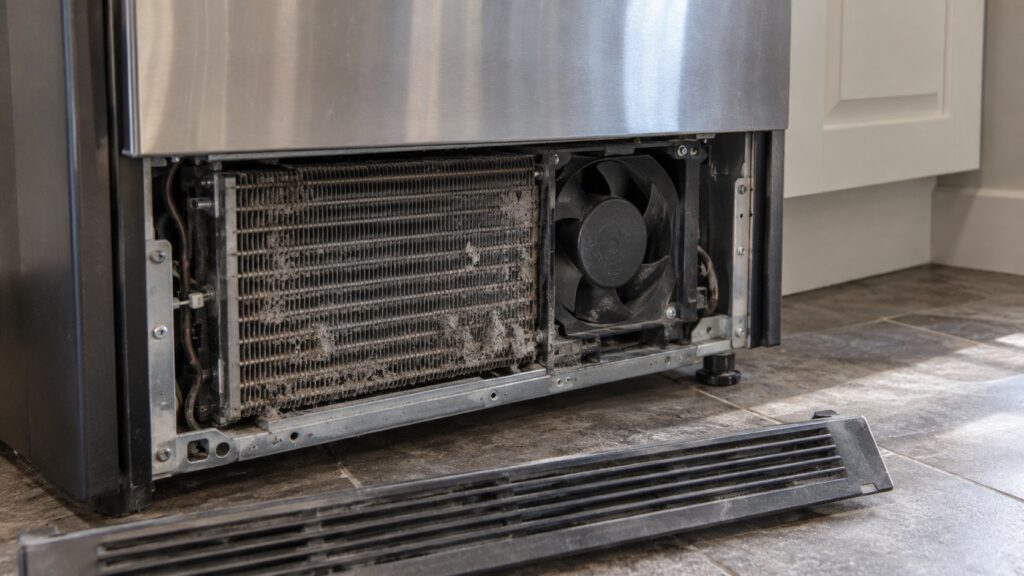
HP has one cause worth checking before anything else: a blocked condenser. An undercounter ice maker breathes through a front grille, and that grille collects dust, pet hair and kick-plate debris until the condenser cannot shed heat. Clearing it resolves a real share of HP complaints. LP has no homeowner equivalent — low pressure means refrigerant has gone somewhere it should not, and that is a sealed-system job.
Do HI and LO mean the same thing as HA?
No, and the distinction is worth holding on to. HA describes the room. HI and LO describe the inside of the unit.
HI means the internal temperature has climbed too high for normal production. It can follow from HA — a unit fighting a hot cabinet eventually loses ground inside — but it can also come from a condenser problem, a door or drawer left ajar, or a failing fan.
LO is the opposite and the more surprising one: the unit is overcooling, which risks freezing the water lines themselves. An ice maker that has frozen its own fill tube stops making ice entirely and often looks, from the outside, exactly like a unit that is not getting water.
What can I check before booking service?
Work from the outside in, and only as far as the front grille:
- Confirm the water supply valve is fully open and the line behind the cabinet is not pinched.
- Note the filter age. Past its rating is a cause, not a detail.
- Pull the front grille and vacuum the condenser fins clean.
- Feel the cabinet run for heat from a neighboring appliance, which explains HA.
- Run the cleaning cycle if CL is showing, then judge the ice afterward and not before.
Stop before the rear panel or anything under the unit. The sealed system, the fill valve wiring and the harvest mechanism all sit there, and an undercounter unit is plumbed, drained and trimmed into cabinetry.
When is the code a service call?
Book when you see E1, LP or HP, when DR persists after the drain line has been checked, or when FL survives a new filter and an open valve. Have the model number from the inner frame, the code, and whether the unit is gravity drained or pumped.
We are an independent repair company, not a factory service arm, and on a sealed-system code we will tell you plainly whether the repair is worth doing on the age of the unit. Pricing starts from a diagnostic visit and we confirm the estimate before any work begins. Jenn-Air ice maker repair covers the water path, the sensor and the sealed system described here, and you can schedule a visit with the code noted down.