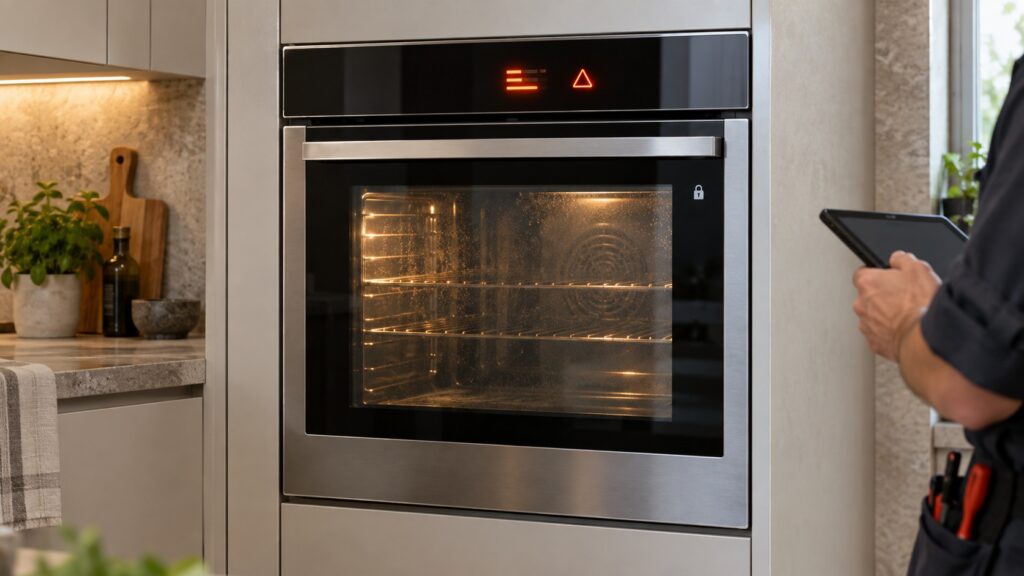
Three codes on a Jenn-Air oven door lock describe the same small assembly from three angles. F5-E1 is a door lock failure — the control asked the lock to move and did not get the confirmation it wanted. F5-E2 is a door lock stuck — the mechanism is in a position it cannot leave. F9-E0 is a door lock motor failure, which points at the motor and gearbox rather than at the switches that watch it. Every one of them usually appears after a self-clean cycle, and every one of them leaves you with an oven you cannot open.
What do the Jenn-Air oven door lock codes mean?
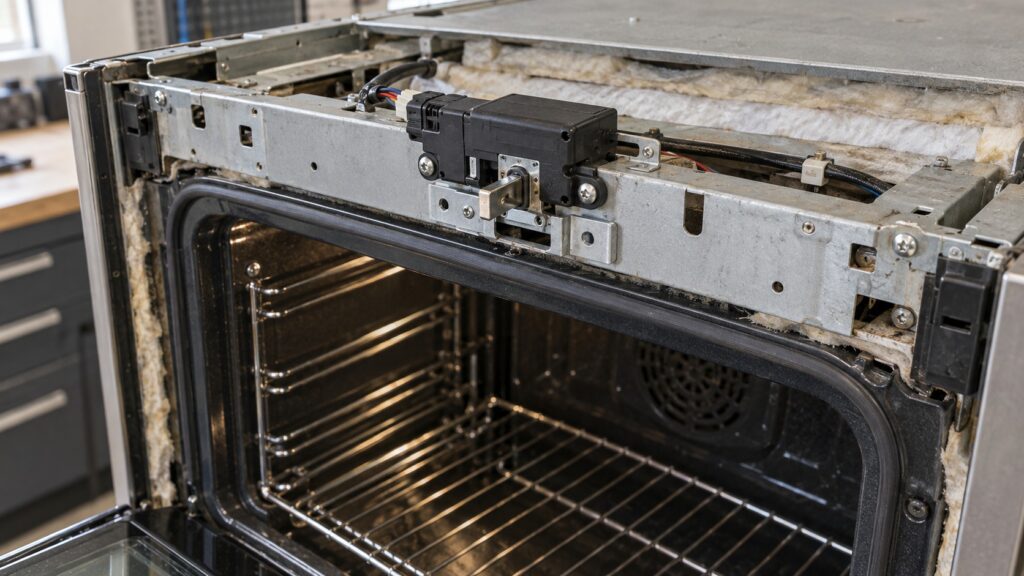
The lock is a motorized bolt with position switches. When a self-clean cycle starts, the control drives the bolt across and waits for a switch to confirm it landed. At the end of the cycle, once the cavity has cooled below a safe threshold, it drives the bolt back and waits for the opposite confirmation.
F5-E1 means one of those confirmations never arrived. The bolt may have moved and the switch failed to report it, or the bolt may not have moved at all. F5-E2 means the assembly is physically stuck. F9-E0 skips the ambiguity and names the motor. In practice the three overlap, because a motor that is failing under load often shows up as a missing confirmation before it shows up as a dead motor.
What none of them means is that the oven overheated. That is a separate fault with its own code, F3-E2, and the distinction matters because the assumption that a lock code equals an overheat sends people looking at the wrong part entirely.
Why does this happen after self-clean?
Self-clean is the only cycle that puts the lock under real stress. The cavity runs far hotter than any baking temperature, and the door, the frame and the lock bolt all expand. The mechanism has to move a bolt through a frame that is not the same shape it was when the cycle started, and it has to do it at the end of several hours at temperature.
Three things make failure more likely. A door hinge that has weakened lets the door sag slightly, so the bolt and the catch no longer line up squarely. Years of spatter carbonized around the lock area add friction. And in a double wall oven such as the JJW2830 or JJW3830 configurations, the upper and lower cavities share a control and a fascia, so heat soak from a long self-clean in one cavity reaches the other cavity’s lock hardware too.
This is also why the codes so often appear on an oven that has just been cleaned for the first time in years. The cycle did not break the lock; it applied the one load the lock is least able to survive after a long period of accumulated wear.
How do I get a locked oven door open safely?
Work through this in order, and do not rush past the first step.
- Wait for the cavity to cool completely. The control will not release the bolt above its safety threshold, and no amount of button pressing changes that. An oven that has just finished a self-clean can need several hours. If the door is locked and the oven is hot, the lock is doing exactly what it should.
- Cancel the cycle and cut power. Press cancel, then switch the oven off at the breaker for five minutes. On restore, many locks run a self-test and release.
- Try a short bake, then cancel. If the control has lost track of the lock position, a brief heat call followed by a cancel sometimes prompts the lock sequence to run again from a known state.
- Read the code again after each attempt. A code that changes from F5-E1 to F5-E2 between attempts tells you the mechanism is moving partway and jamming, which is useful information for the visit.
If none of that releases the door, stop. There is no safe consumer method for forcing a wall oven door lock open.
Is F2-E0 an overheat code on a Jenn-Air oven?
No. On this brand, F2-E0 is a keypad short circuit — a control panel fault where a key is reading as shorted or held. It is worth stating plainly because the code is widely described elsewhere as an over-temperature fault, and that misreading leads people to replace temperature sensors on an oven whose only problem is a touch panel.
If your oven shows F2-E0 alongside a lock code, the likely story is the panel rather than the lock: a control that cannot read its own keys reliably may also be mishandling the lock sequence. The genuine heat fault is F3-E2, and a sensor complaint about uneven baking is a different matter again, covered in our guide on uneven oven heating.
What makes the lock motor fail?
Almost always load rather than age. The motor is small and geared, sized for a bolt that slides freely. Anything that adds resistance — a sagging door, carbonized grease, a bent catch, debris in the track — makes the motor work against a load it was never sized for. It stalls, the gears take the strain, and a plastic gear tooth eventually gives way. That is the point at which a lock code becomes permanent rather than intermittent.
The warning sign, if you catch it, is sound. A lock that used to move with a short clean click and now grinds, buzzes or takes several seconds has already started down this path. Running another self-clean cycle at that point is what turns a straightforward repair into a locked door with food inside.
What should I not attempt myself?
Do not pry the door, do not lever the latch with a tool through the gap, and do not remove the door while the lock is engaged. The lock assembly sits on the top frame of the cavity under the control fascia, directly among the control wiring and immediately above a cavity that holds heat for hours. Prying also bends the frame and the catch, which converts a part replacement into a door and frame alignment job.
On a double wall oven, do not attempt to pull the unit from the cabinet. These are heavy, hard-wired, and supported by the surround; removal is a two-person job with the circuit isolated first.
When should I book service?
Book when the door is still locked after a full cooldown and a power cycle, when the lock grinds or buzzes, or when any of the three lock codes returns on a second attempt. Tell us the code, whether the cavity is empty, whether it followed a self-clean, and whether the oven is a single or double wall configuration — that decides what has to come apart.
We are an independent repair company, not a factory service arm, and with a locked cavity we will tell you before the visit what can realistically be done on site. Pricing starts from a diagnostic visit and we confirm the estimate before any work begins. Jenn-Air oven repair covers the lock assembly, the motor and the control described here, and you can schedule a visit once the oven has cooled.