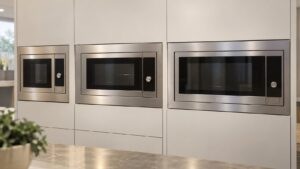
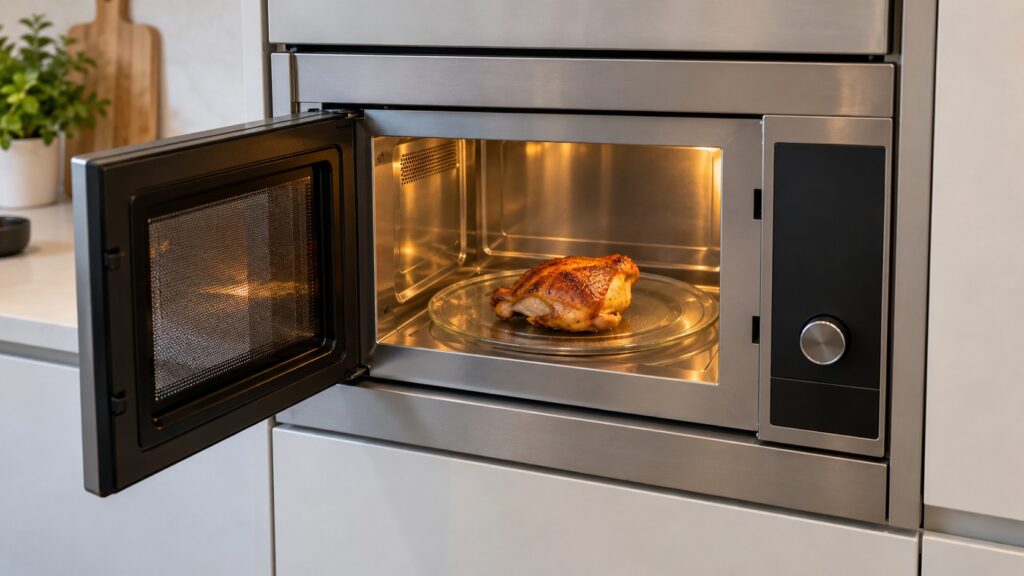
A Jenn-Air Speed-Cook microwave cooks with two kinds of heat at once. Microwave energy heats the water inside the food quickly and from within, while a convection element and fan blow hot air around the cavity to brown and crisp the outside. A plain microwave cannot brown, and a plain oven cannot cook fast. Speed-Cook blends them, so a dish that would take an hour in an oven can come out cooked through and browned in a fraction of that time.
What is a Speed-Cook microwave from Jenn-Air?
The Speed-Cook name belongs to Jenn-Air’s convection microwaves. On our site, the JMC2427LM and the JMC2430IL are listed as built-in microwave ovens with Speed-Cook convection, and the JMW2427LM is a combination of a microwave and a wall oven. In all of them the idea is the same: use the speed of a microwave together with the steady heat of convection, so the food cooks fast and still looks and tastes roasted instead of steamed.
That matters for the kinds of dishes a microwave usually ruins. Chicken pieces, a baked potato, a frozen pizza and a casserole all dry out or turn soggy in a microwave alone, because the surface never gets hot enough to crisp. The convection half fixes that.
How does the microwave half heat food?
A part called the magnetron generates microwave energy, and a metal channel guides it into the cavity. Water, fat and sugar molecules in the food absorb the energy and vibrate, and the vibration creates heat inside the food. A rotating turntable or a stirring system moves the food through the energy so that it heats evenly.
Because the heat starts inside the food, microwaves cook quickly but only reach a limited depth, which is why large dishes are cooked in stages and left to rest. They also cannot brown food, since the air and the cavity walls stay cool.
How does the convection half add browning?
A heating element warms the air in the cavity, and a fan pushes that air around the food. The moving hot air strips moisture from the surface and raises its temperature enough to brown, which is what gives roasted food its color and crust. This is the same principle as a convection oven, and our guide to how Jenn-Air MultiMode convection works goes into it for full-size ovens.
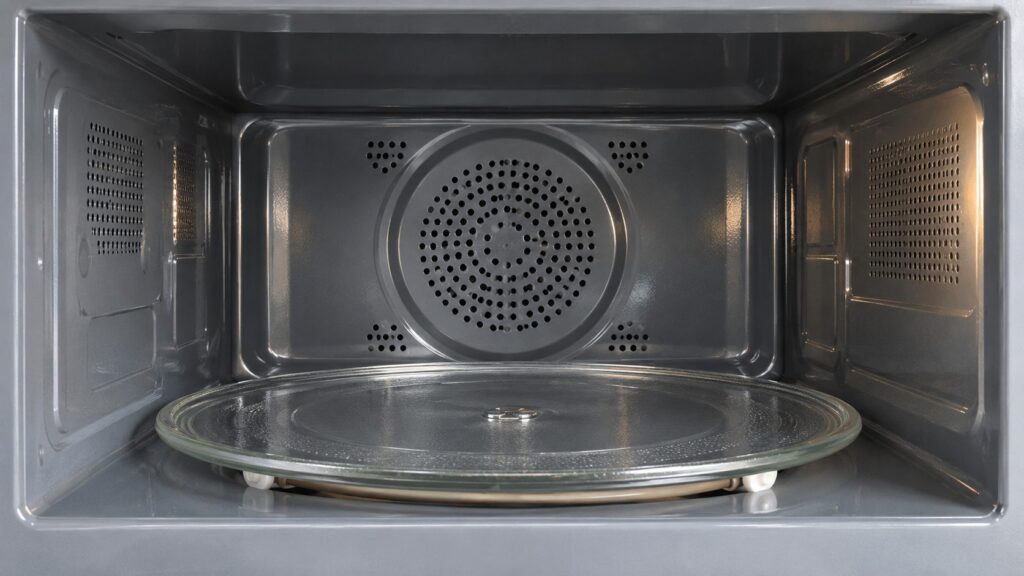
What happens when both run together?
In Speed-Cook, the control blends the two. The microwave energy brings the center of the food up to temperature quickly, while the convection heat browns the outside during the same cycle. The control may alternate between them or run them together, depending on the program, and you usually set a time or choose a preset instead of controlling each heat source. The result is a shorter cook than a conventional oven would need, with better color than a microwave alone.
Some models also have a humidity sensor for sensor cooking. As food heats, it gives off steam, and the sensor reads it. The control uses that reading to decide when the food is hot, instead of relying on a timer you guessed. On our site, F4 and F8 describe humidity sensor faults on Jenn-Air microwaves, which is why a sensor program may stop working before ordinary timed cooking does.
Which cookware is safe in each mode?
The rules change with the mode, so read your use and care guide before you use anything unusual.
- Microwave mode: use microwave-safe glass or ceramic. Keep metal, foil and dishes with metallic trim out of the cavity, because they can arc.
- Convection mode: use oven-safe cookware, such as metal pans, glass and ceramic. Plastic and paper that are only microwave-safe can melt or burn.
- Speed-Cook: use cookware that is both microwave-safe and oven-safe, and follow the manual on whether a metal rack is allowed in that mode.
The cavity and the door get hot in convection mode, so use oven mitts and keep children away.
Which parts do the work, and what goes wrong?
Speed-Cook relies on a short list of parts: the magnetron and its high voltage circuit, the convection element and fan, the humidity and temperature sensors, the door switches and the control board. Our site reports the convection fan as F7 on Jenn-Air microwaves. A fan that fails can leave convection cooking weak or stop the cycle completely, even when ordinary microwave heating still works.
The high voltage parts are not safe to test at home, because the capacitor can hold a lethal charge even when the unit is unplugged. If your microwave heats poorly or not at all, read our guide to a Jenn-Air microwave not working, and see the microwave installation guide if you are resetting a built-in unit into its opening. Convection models need free ventilation around the unit, so a blocked vent can cause overheating.
When should you call a technician?
Call when convection mode does not heat, when the microwave runs without warming food, when a code such as F7 returns, or when you hear a grinding fan. Our Jenn-Air microwave repair technicians test the fan, the element, the sensors and the high voltage circuit safely. We are an independent repair company, not a factory service arm, and we will tell you when a repair is not worth doing. You can book a visit with the model number.