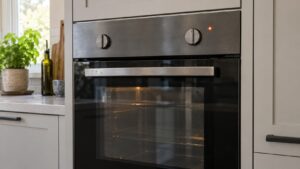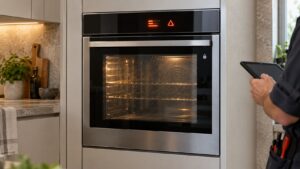
This guide explains the Jenn-Air Oven F3-E1 Error: what it means, what causes it, and how to resolve it safely.
This guide explains the Jenn-Air F3-E1 Error 2: what it means, what causes it, and how to resolve it safely.
Understanding the Jenn-Air Oven F3-E1 Error
Below, our specialists break down everything you need to know about the Jenn-Air Oven F3-E1 Error.
Understanding the Jenn-Air F3-E1 Error 2
Below, our specialists break down everything you need to know about the Jenn-Air F3-E1 Error 2.
What F3-E1 means on your Jenn-Air wall oven
A Jenn-Air F3-E1 error on the panel is the unit’s way of reporting lower sensor short rather than a random glitch. The F3-E1 error code on Jenn-Air double wall ovens indicates the lower oven temperature sensor has a short circuit. Manufacturers design error codes like F3-E1 so that a technician (or a patient owner) can skip straight past guesswork and go directly to the part of the wall oven most likely responsible. That’s the whole point of a numbered code instead of a single generic warning light.
What that looks like day-to-day is the sensor is returning a resistance value that is too low, causing the control to read an incorrectly high temperature. A reset clears the error temporarily, but the shorted sensor will trigger it again during the next heating cycle. If you own more than one Jenn-Air appliance, it’s worth remembering that error codes aren’t standardized across every category — F3-E1 on a wall oven can mean something entirely different on a dishwasher or refrigerator from the same brand, so always match the code to the specific appliance type before drawing conclusions.
Symptoms
Along with F3-E1, keep an eye out for these related behaviors on the wall oven, since they help confirm the diagnosis:
- The F3-E1 code shows on the wall oven’s display, sometimes with a beep sequence.
- Normal wall oven operation is interrupted or blocked while F3-E1 is present.
- Sensor resistance is below 900 ohms at room temperature.
- Wiring shows bare copper touching grounded metal.
- Sensor probe is discolored or physically damaged.
Common causes
In roughly descending order of how often we see them on a wall oven, the usual suspects behind F3-E1 are:
- Shorted sensor probe: the RTD sensor inside the lower oven has developed a short circuit, giving a low resistance reading. Because this generally isn’t something an owner can safely repair without replacement parts and test equipment, it’s usually flagged for a professional from the start.
- Pinched or damaged sensor wiring — the sensor wire is touching a grounded metal surface, creating a short to ground. Because this generally isn’t something an owner can safely repair without replacement parts and test equipment, it’s usually flagged for a professional from the start.
Troubleshooting steps you can try
Start from the top of this list and stop on the wall oven as soon as either F3-E1 clears or you reach a step marked as requiring tools you don’t have on hand.
- Check sensor wiring for pinch points. Turn off the breaker and inspect the sensor wire routing inside the lower oven for any spots where the wire touches metal surfaces. Wires can get pinched by oven racks or the oven door hinge mechanism. This step is safe for most owners to try without any special equipment or electrical experience.
- Measure sensor resistance. Disconnect the sensor and check resistance at room temperature — should be around 1,080-1,100 ohms. A reading significantly below 1,000 ohms confirms a shorted sensor. Proceed only if you’re comfortable working near exposed wiring and have cut power first — otherwise, this is a reasonable point to stop and hand things to a technician instead of pushing further on your own.
If F3-E1 keeps returning on the wall oven despite trying each of these, further testing really does require a meter and some familiarity with the platform’s wiring diagram.
When to call a technician
Signs that this has moved past a DIY fix include: Sensor resistance is below 900 ohms at room temperature; Wiring shows bare copper touching grounded metal; Sensor probe is discolored or physically damaged. Given what’s at stake with F3-E1, most owners are better served scheduling a visit than chasing the problem further on their own. A technician’s multimeter and factory service reference make diagnosing F3-E1 fast — testing resistance and continuity in the field takes minutes and removes the guesswork that trial-and-error part swapping introduces.
A power cycle can clear the F3-E1 display temporarily, but that alone rarely fixes what triggered it in the first place on this wall oven. If you’d rather not open up the wall oven yourself, schedule a service visit and one of our specialist technicians will bring the right meters and parts knowledge to diagnose it properly. You can also browse other Jenn-Air error codes we’ve documented, or check jennair.com for model-specific service bulletins.