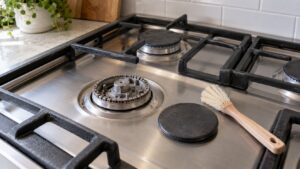

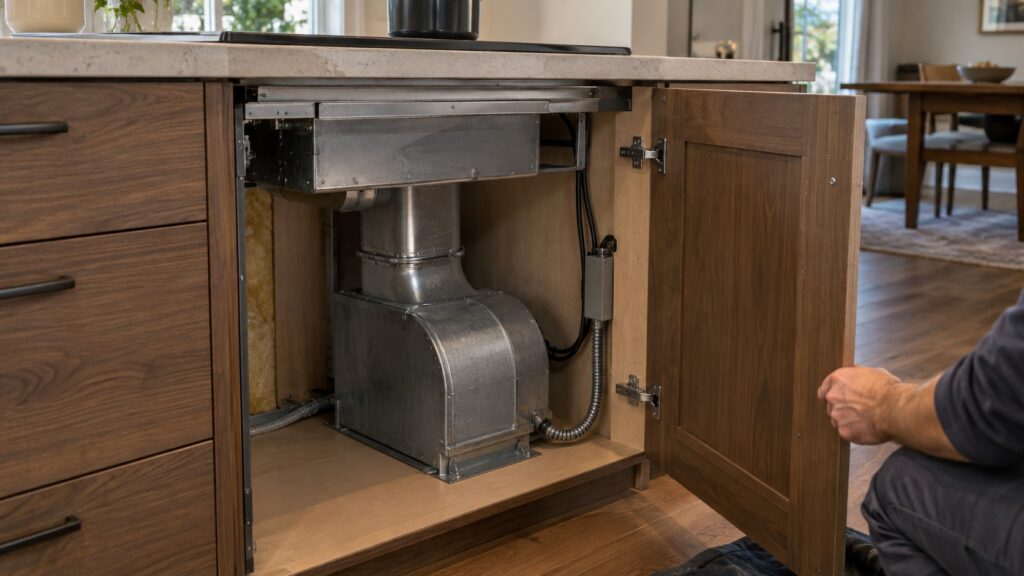
A downdraft ventilation repair or replace decision has one complication that a hood does not: most of the system is buried. The blower sits under the counter, the ducting runs below the floor or through cabinetry, and the lift assembly is inside the cooktop opening. That makes replacement a bigger job than it looks and repair more attractive than it looks — which is why this decision deserves real numbers rather than a glance at a showroom price.
First, find out which half has failed
These systems are two machines in one: a lift that raises and lowers the vent, and a ventilation system that moves the air. They fail independently and they cost very different amounts to fix. A vent that will not rise while the blower runs is a lift fault; a vent that rises but pulls nothing is a ventilation fault.
That distinction decides the whole conversation, and it is one an owner can make in thirty seconds by standing still and listening with the kitchen quiet. Our guide on a vent that will not rise walks the lift side, and it is worth doing before any quote is requested.
Lift faults are the cheap ones
A lift motor, a drive belt or a position switch are modest parts in a system that is otherwise sound, and they are the most common failures on a downdraft simply because they are the only moving parts that do heavy work. A slot packed with grease is not even a fault — it is maintenance that was skipped, and cleaning it restores the travel without a single part being bought.
The exception is a lift that has been forced repeatedly. Stripped drive components and bent guides turn a small job into a larger one, which is the practical argument for calling early rather than continuing to press the switch.
Ventilation faults: check the duct before the blower
Weak suction is blamed on blowers far more often than blowers deserve, and a blower is the most expensive part in the system. Downdraft ducting is long, turned and out of sight, and it accumulates grease along its whole length. A damper stuck half-closed, a crushed section of flexible duct under a floor, or an exterior cap blocked by a nest will each strangle a perfectly healthy blower.
A technician can measure airflow and inspect what is reachable, and that inspection is the difference between replacing a blower that was fine and clearing the duct that was not. Our guide on how downdraft ventilation works explains why the duct matters so much more here than on an overhead hood.
What replacement actually involves
The third row is the one that surprises people. Where the ventilation is built into the cooktop rather than fitted beside it, a failed downdraft is a cooktop decision, and the comparison should be made against a new cooking appliance rather than against a vent.
There is a middle path worth knowing about, because it is often the right answer and nobody offers it unprompted: rework rather than replace. Cleaning or re-routing a section of duct, fitting a new damper, or replacing a crushed flexible run with rigid pipe can restore a system whose blower and lift are both healthy. It costs less than a new appliance, it does not touch the cooktop, and it fixes the thing that was actually wrong.
Age and the parts question
Downdraft systems are mechanically simple and they last. Fifteen years is not old for one, and the components that fail — motors, belts, switches, dampers — are the kind of parts that stay available or have equivalents. What ends a system’s life is usually a control board for a discontinued model, or a corroded blower housing where moisture has been sitting for years.
Ask the technician two direct questions: is the part still supplied, and is anything else in the system close to failing. The answers turn a coin-toss into a decision, and they are the same two questions that settle most appliance dilemmas anywhere in the kitchen.
The case for repairing
A downdraft that is repaired keeps a working duct run, a fitted cooktop and a kitchen that does not need opening up. A replacement brings a warranty and possibly better airflow, but it arrives with carpentry attached. Unless the duct itself is the problem or the cooktop is being replaced anyway, repair is usually the shorter, cheaper path — and if you are weighing the system against a hood instead, our guide on downdraft versus overhead ventilation covers that comparison.
One practical note for anyone weighing this during a remodel: if the cooktop above the vent is being replaced anyway, price the pair together. Matching a new cooktop to an existing downdraft, or a new downdraft to an existing cooktop, is where compatibility surprises live — cutout sizes, blower positions and control integration all have to agree. Two appliances chosen together fit; two chosen a decade apart often need carpentry to meet in the middle.
When to call
Call when the lift hums without moving, when suction has faded with clean filters, when a damper rattles or sticks, when the blower has become noisy, or when you want an honest assessment before committing to a kitchen change. Diagnosing which half has failed is quick and it changes the price by an order of magnitude.
We are an independent repair company and not a factory service arm. Pricing starts from a diagnostic visit, and we confirm the estimate before any work begins. Jenn-Air cooktop repair covers downdraft lift assemblies, blowers, dampers, switches and controls, and you can schedule a visit online.