
The downdraft vs overhead ventilation decision is usually made for the wrong reason — how it looks — and then lived with for fifteen years. Both systems remove smoke, steam and grease; they do it with different physics, they suit different kitchens, and they cost different amounts to install and to keep working. This guide lays out the real trade-offs so the choice is made on the kitchen you actually have.
Why a hood has an easier job
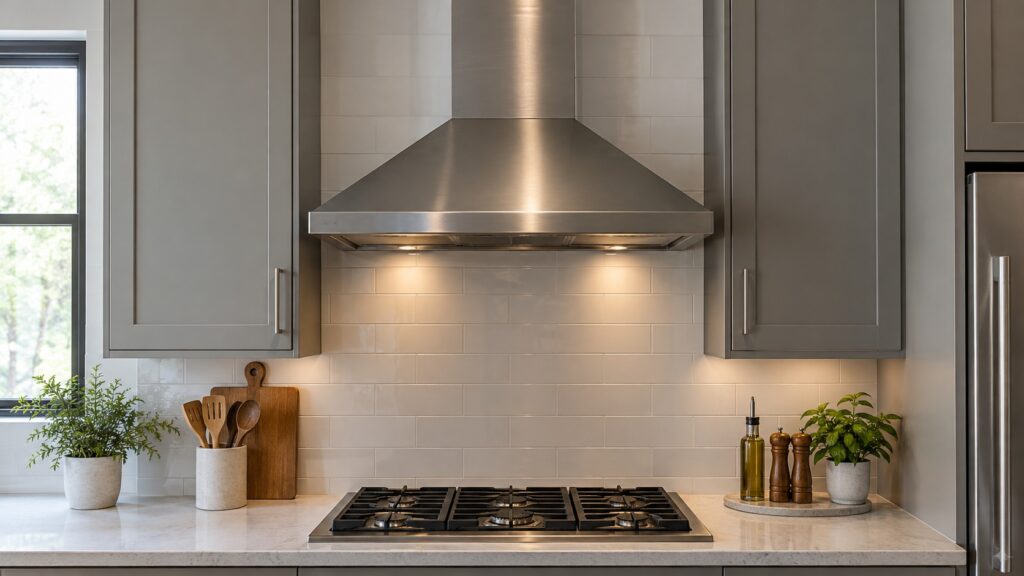
Smoke and steam rise. A hood sits where they are going and catches them; the appliance only has to move air that is already heading in the right direction. That is why a well-sized, well-ducted hood is the more effective system in a straight comparison, and why professional kitchens use them.
Downdraft asks air to travel the other way — sideways across the cooking surface and then down. It succeeds by moving more air over a shorter distance, capturing at the source before the plume has risen. It works, genuinely, and it works best on the burners nearest the vent and least well on a tall pot at the far side of the cooktop.
Where downdraft wins outright
Islands and peninsulas. No hanging hood, no bulkhead, no sightline broken across an open-plan room. For many kitchens this is the entire argument, and it is a legitimate one.
Low ceilings and windows. A hood needs mounting height above the cooking surface. Where a window sits behind the cooktop or the ceiling is low, a downdraft that disappears into the counter is the only realistic option.
Visual quiet. A downdraft is invisible when it is down. Some kitchens are designed around that, and no hood — however slim — achieves it.
Where an overhead hood wins
Capture on tall pots. A stockpot’s plume rises above a raised vent; a hood catches it. If you brew, can or boil large volumes, that matters.
Ducting. A hood usually has a shorter, simpler run — straight up or straight back. Downdraft ducting travels under the floor or through cabinetry, with more length and more turns, and every one of those costs airflow.
Simplicity. A hood has a blower, filters, lights and a switch. A rising downdraft adds a lift motor and its drive — one more system to maintain, and the one that generates the most calls, as our guide on a vent that will not rise describes.
Cost in a retrofit. Adding a downdraft to an existing kitchen usually means new ducting under a floor. Replacing a hood is often a same-day job.
Noise, at the level you hear it. A downdraft blower usually sits under the counter, close to the cook and often close to a dining area; a hood’s blower is above head height, and on some installations it is remote — mounted in the attic or outside, which makes the kitchen dramatically quieter at high speed. If someone in the household is sensitive to fan noise, a remote blower is the strongest argument a hood has.
Recirculating, if there is no way out. Both systems can be fitted without an exterior duct, passing air through charcoal filters and returning it to the room. That removes grease and some odor and returns heat and moisture, and it needs the charcoal filter replaced on a schedule to keep doing even that. It is a legitimate choice in an apartment or an interior kitchen, and a disappointment when it is discovered rather than chosen.
What decides it in practice
Two things apply whichever you choose. Airflow claims are measured in CFM and describe the blower, not the installed system — duct length, diameter and turns all take their share. And a powerful system in a tight, modern house may need makeup air; check the local requirement for the airflow you are installing before the drywall goes up.
Living with each one
A hood asks for its grease filters to be washed and its duct and damper to stay clear. A downdraft asks for the same filters plus the slot the tower rises through, which collects grease and eventually stops the lift. Neither is demanding, but the downdraft has one more failure mode and it is a mechanical one.
Both reward being used properly: start the fan before the pan gets hot, run it for a few minutes after cooking, and use a lower speed for simmering — on a downdraft, a high fan speed next to a low gas flame can pull the flame sideways. The routine care for both lives in our guide on cooktop maintenance, and the mechanics of the downdraft system are covered in how downdraft ventilation works.
Whichever system you choose, decide the duct route before the cabinetmaker starts. That single decision sets what the ventilation can achieve for the life of the kitchen: the diameter, the number of turns, where the cap sits on the building, and whether makeup air is needed. Appliances can be swapped in an afternoon years later; a duct buried under a floor or inside a soffit is the part nobody wants to revisit, and it is the part that decides whether the kitchen smells of last night’s dinner.
When to call
Call when an existing system pulls poorly, when a downdraft will not rise or lower, when a damper rattles, or when you would like the duct run assessed before committing to one system or the other in a remodel. Getting the ducting right before the cabinetry closes is the cheapest good decision available in this whole subject.
We are an independent repair company and not a factory service arm. Pricing starts from a diagnostic visit, and we confirm the estimate before any work begins. Jenn-Air cooktop repair covers downdraft lift motors, blowers, dampers and controls, and you can schedule a visit online.