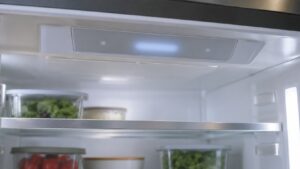
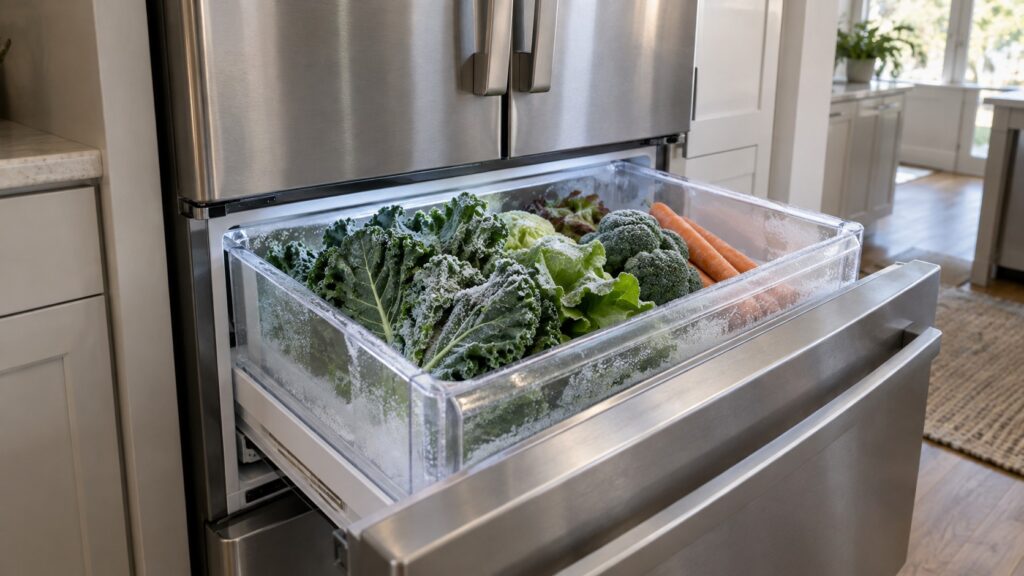
A Jenn-Air refrigerator too cold in the fresh-food section — lettuce with ice crystals, milk slushy at the back, eggs frozen to the carton — is almost never a compressor running hard. It is a control problem: a thermistor reporting a warmer number than reality, a damper stuck open, or a defrost cycle that is not running so the evaporator hoards cold. On the built-in counter-depth French door models in the JFFCC72 series, the fresh-food compartment is fed through an air damper from the freezer side, which is exactly why this fault shows up here more than on a freestanding box.
Why is my Jenn-Air refrigerator too cold and not too warm?
Both faults come from the same handful of parts, which is why the diagnosis surprises people. The board decides how much cold air to send into the fresh-food compartment based on what a small thermistor tells it. If that sensor drifts high — reports 42 degrees when the compartment is actually 34 — the board keeps calling for more cold. The compressor obliges, the damper stays open, and produce freezes while the display reads a perfectly sensible setpoint.
The second route is mechanical. The damper between the freezer evaporator and the fresh-food duct is a motorized flap. Frost buildup, a bent flap or a failed damper motor can leave it propped open, at which point freezer air pours into the fresh-food side continuously regardless of what any sensor says.
The third route is defrost. When the automatic defrost cycle stops running, the evaporator ices over. Early on, before airflow chokes off entirely, this can actually make one compartment colder rather than warmer, because the ice mass holds temperature and the fan runs longer to compensate.
What should I check before assuming a part failed?
Four things account for a surprising share of too-cold calls, and none of them is a repair:
- The setpoint itself. A cleaning cloth across the panel, a child at eye level with the controls, or a power event can leave the fresh-food setting several degrees lower than you remember. Set it to 37 degrees and the freezer to zero, then leave it alone for a day.
- Where the food sits. The coldest air enters the fresh-food compartment through vents near the top rear on these built-ins. Produce pushed hard against that vent freezes while the rest of the compartment is fine. Leave a hand’s width of clearance.
- The crisper humidity sliders. Sealed high-humidity drawers hold moisture against cold walls, which frosts greens that would be fine elsewhere in the same compartment.
- A recently emptied refrigerator. A nearly empty compartment has almost no thermal mass, so it overshoots on every cooling call. A few bottles of water restore stability.
If the compartment is still freezing food after 24 hours at a correct setpoint with the vents clear, the problem is in the control chain rather than in habits.
What does the RS code mean on a Jenn-Air refrigerator?
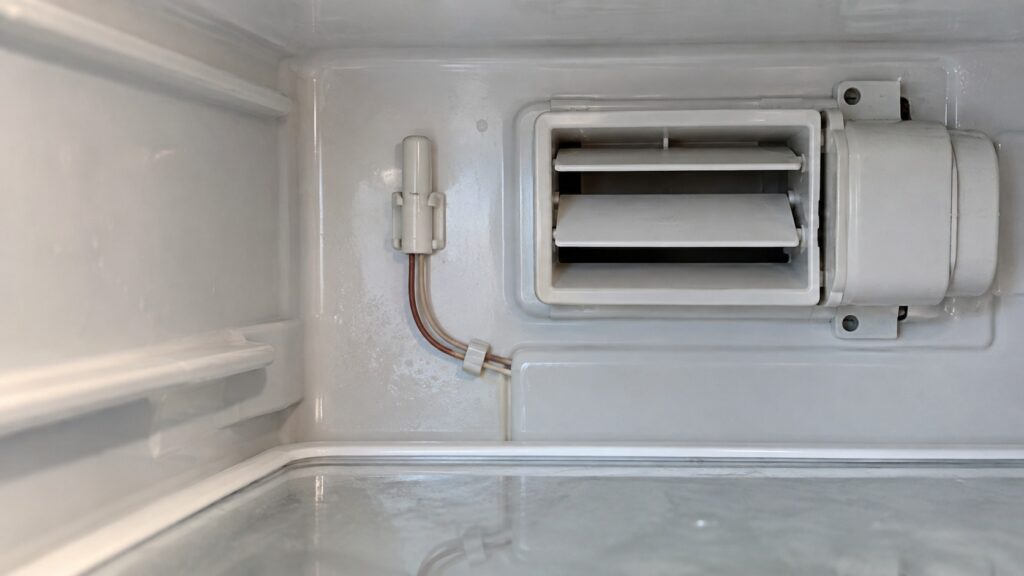
The RS code is the one that matches the too-cold symptom most directly: the thermistor watching the fresh-food compartment has drifted or failed, so the board can no longer regulate cooling accurately. It is a small two-wire sensor, usually clipped to the rear wall of the compartment near the air duct.
What makes RS worth knowing is that it often does not appear. A sensor that has failed outright takes the board out of range and posts the code. A sensor that has merely drifted stays inside the plausible band, posts nothing, and quietly freezes your produce for months. So an absent code does not clear the sensor — it only means the sensor has not failed in a way the board can recognize.
The DF code is the other one to watch for, because a defrost problem and a sensor problem can produce the same complaint from opposite directions.
How do I tell a sensor fault from a damper fault?
A simple observation separates them, and it costs nothing but a thermometer and patience. Put a glass of water with a thermometer in the middle shelf of the fresh-food compartment and leave it six hours. Then compare three numbers: what the thermometer says, what the display says, and where you set it.
- Thermometer much colder than the display and the setpoint: the board thinks it is warmer than it is. That is a sensor or board reading problem.
- Thermometer colder than setpoint, and the compartment is cold even right after the compressor stops: suspect the damper, because cold is arriving when nothing is calling for it.
- Frost on the rear wall of the freezer side, and a fan that sounds louder or runs constantly: suspect defrost. A defrost problem builds over weeks and usually ends in a warm refrigerator, so catching it at the too-cold stage is fortunate.
This is also the difference between this fault and the opposite complaint covered in our refrigerator not cooling guide: there the cold is missing, here it is misdirected.
Does a power outage explain it?
It can. The PO code says the unit lost and regained power, and on these built-ins a hard power event occasionally leaves the control in a recovery state where it overcools for a period. If the too-cold behavior started within a day of a storm or a breaker trip, cut power at the breaker for five minutes, restore it, and give the refrigerator a full day at a normal setpoint before judging.
What a power event does not explain is a slow slide over several months. A drifting thermistor, frost accumulating on an evaporator, or a damper flap gradually losing its seat all take time. The timeline is one of the most useful things you can tell a technician.
What should I not attempt on a built-in?
Stop at the point where a panel comes off. On the JFFCC72 series the fresh-food thermistor, the damper assembly and the evaporator all sit behind interior panels that also carry the wiring harness and, in the freezer section, the defrost heater. These are not casual-access parts. A built-in column is also heavy, cabinet-trimmed and plumbed for water, so pulling it out for rear access is a two-person job that can damage both the unit and the surround.
Keeping the condenser area clean and the door seals sound prevents the defrost side of this problem; our refrigerator maintenance guide covers the routine for a built-in installation.
When is it worth booking service?
Book when food is freezing at a correct setpoint after a full day, when frost keeps returning to the rear freezer wall, or when the display and a thermometer disagree by more than a few degrees. Have the model number from the sticker inside the fresh-food compartment, the thermometer reading, and any codes you have seen.
We are an independent repair company, not a factory service arm, and on a built-in we will tell you plainly whether a sensor, a damper or a sealed-system issue is in front of you before anything is ordered. Pricing starts from a diagnostic visit and we confirm the estimate before any work begins. Jenn-Air refrigerator repair covers the control chain described here, and you can schedule a visit once you have your six-hour thermometer reading.