
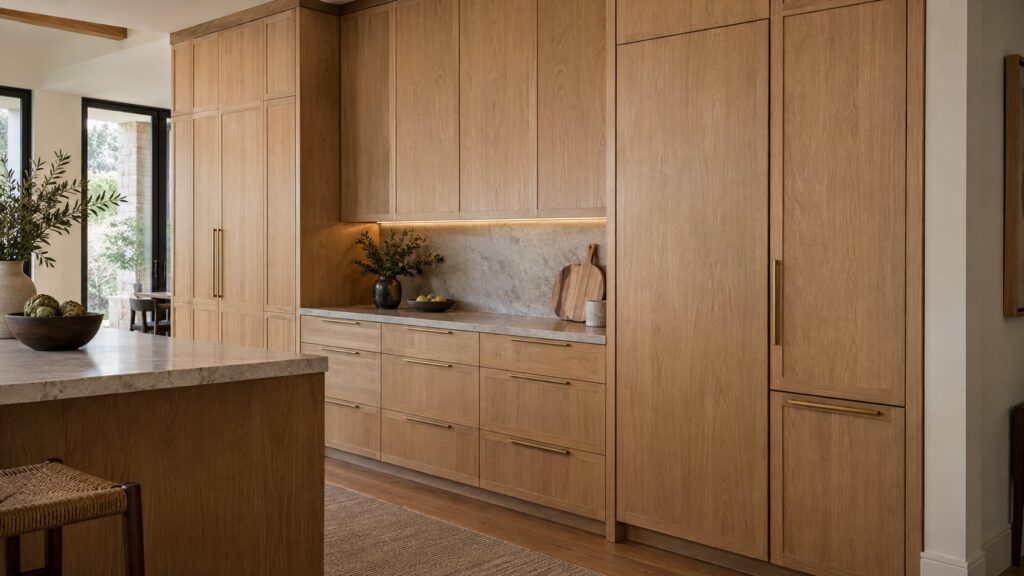
What does panel-ready mean on a Jenn-Air appliance? It means the appliance is built to disappear into cabinetry rather than to be seen. A panel-ready refrigerator, dishwasher, or wine cellar ships without a finished stainless or printed front — instead it has a mounting frame designed to accept a custom panel that matches the surrounding kitchen cabinets, so from across the room the appliance reads as another cabinet door rather than as a visible machine.
What does panel-ready mean on a Jenn-Air appliance?
Panel-ready describes an appliance that leaves the factory without a finished front. In place of that finish is a mounting frame with a defined thickness tolerance, brackets, and clearances designed for exactly one purpose: accepting a panel supplied by a cabinet maker and cut to that appliance’s specific dimensions. The appliance still has its own door, latch, and hardware underneath — the panel is an outer layer fastened over that structure, not a replacement for it.
The term shows up on spec sheets and in showrooms more often than it gets explained, and that gap causes real ordering mistakes. A buyer who assumes “panel-ready” simply means “will look nice in my kitchen” can end up with a mounting frame and no plan for what covers it, or with a panel ordered from a generic template that does not match the specific model’s bracket layout. Treating the term as a checklist item — confirm it applies, confirm what it requires, confirm who is supplying the panel — avoids both mistakes.
Which Jenn-Air appliance types come in panel-ready versions?
Refrigerators, dishwashers, and under-counter wine cellars are the three appliance types on this site’s lineup most commonly sold as panel-ready, because all three are typically installed flush with cabinetry and benefit most from disappearing into it. Ranges, wall ovens, and cooktops are not sold panel-ready in the same way, since their controls and cooking surface have to remain visible and accessible regardless of the surrounding cabinet finish.
Is panel-ready the same thing as built-in?
No, and the two terms get confused often enough to cause ordering mistakes. Built-in describes how an appliance is installed — flush with the cabinetry, with defined clearances, rather than freestanding with finished sides that show. Panel-ready describes what covers the front once it is installed. An appliance can be built-in with a factory stainless finish, or built-in and panel-ready at the same time; the two properties are independent of each other, and a buyer choosing between models needs to check both separately rather than assuming one implies the other.
What is an overlay panel, and how is it different from a full panel-ready front?
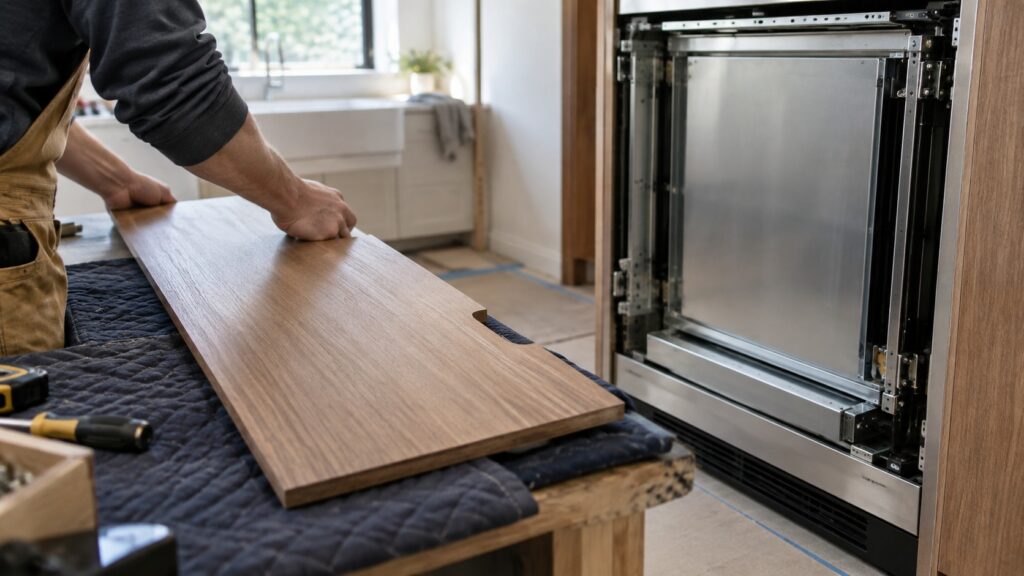
An overlay panel sits on top of an appliance’s existing trim rather than replacing the entire front the way a true panel-ready mounting frame does. It is a lighter-weight option used on some dishwasher and wine-cellar models where a full panel-ready conversion is not offered, and it usually has a narrower panel-thickness tolerance than a dedicated panel-ready frame. Anyone shopping by spec sheet should check which of the two a given model actually offers, since “accepts a decorative panel” and “panel-ready” are sometimes used loosely for what are actually two different mounting systems.
The practical difference shows up at install time more than in the showroom. A true panel-ready frame is designed around the panel from the start, so the reveal lines and gaps end up close to what a cabinet door would show. An overlay panel is added after the fact, and depending on how well it is trimmed, it can sit slightly forward of the surrounding cabinet faces rather than perfectly flush. Neither is wrong for every kitchen, but a buyer expecting a seamless cabinet run should confirm which system a specific model uses rather than assuming the two terms describe the same result.
Does an integrated handle change how the panel gets ordered?
Yes. A panel meant to pair with an integrated handle is cut with a notch or recess for that hardware, while a panel meant for a surface-mounted handle is cut flat and the handle is added afterward. Ordering the wrong version of the panel for the intended handle style is one of the more common fitting mistakes, and it is worth confirming with the appliance’s installation documentation before the panel goes to the cabinet shop, not after.
A handle style decided after the panel is already cut usually means either living with a surface-mounted handle that was not the original plan, or paying to route a recess into a panel that was cut flat. Deciding the handle style at the same time as the panel dimensions, rather than as a later finishing touch, is the cheaper order of operations by a wide margin.
Where does panel-ready terminology matter most for a buyer?
It matters most at the ordering stage, before the appliance and the panel are both committed. A buyer choosing between a Jenn-Air refrigerator’s built-in and freestanding configurations should treat panel-ready as a separate, additional decision layered on top of that choice, not a synonym for it. The same logic applies to sizing a wine cellar — a panel-ready under-counter unit still has to fit the opening correctly before the panel question comes up at all.
Where can I read more about a specific panel-ready model?
For a worked example of choosing a panel-ready appliance and what has to be ordered alongside it, see this site’s guide to the panel-ready JDPSS245LX dishwasher, which walks through the mounting-frame tolerance and the separate panel order in detail. The same checklist — confirm the tolerance, confirm the handle style, order the panel only after the appliance itself is in the room — applies whether the appliance in question is a dishwasher, a refrigerator, or an under-counter wine cellar.
We are an independent repair company, not a factory service arm, and we will tell you when a repair is not worth doing. Pricing starts from a diagnostic visit and we confirm the estimate before any work begins. Refrigerator installation and setup covers the built-in clearances a panel-ready unit still has to meet, and you can schedule a visit for help fitting or servicing a panel-ready appliance.