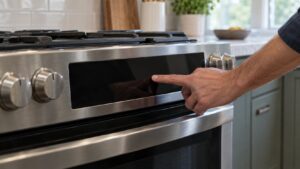
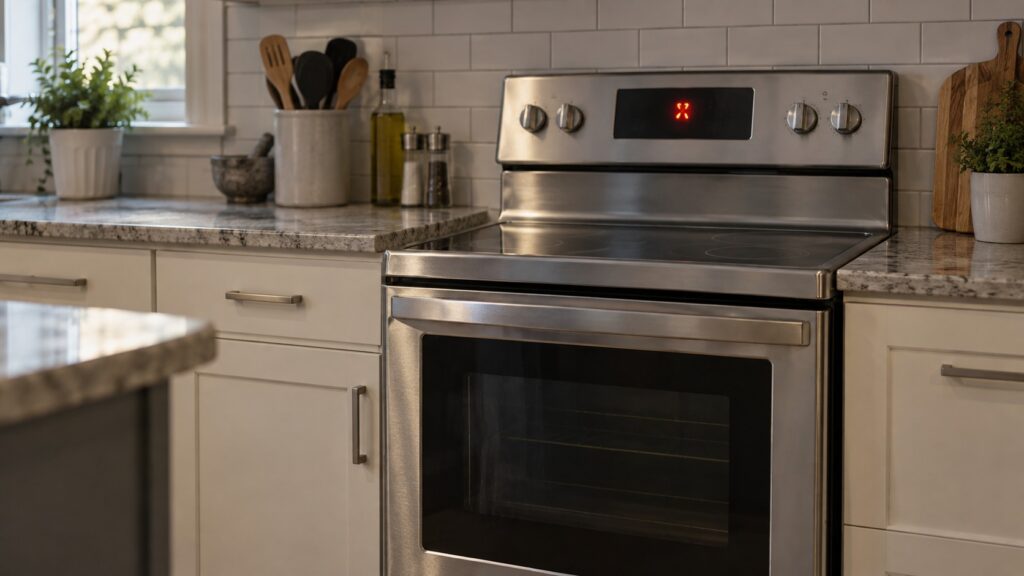
Jenn-Air range F8-E0 is a communication fault between its analog and digital control boards — the two boards that split the work of reading sensors and driving relays are no longer talking to each other correctly. Whether that is worth repairing, or a sign to start pricing a replacement range instead, depends less on the code itself than on the range’s age and what else has already failed.
What does Jenn-Air range error F8-E0 actually mean?
A Jenn-Air range that splits its control functions across two boards — one handling analog signals from sensors and switches, the other handling the digital display and higher-level logic — depends on a clean line of communication between them. F8-E0 means that link has broken down: the digital side is not receiving valid data from the analog side, or the reverse. The range typically locks out cooking functions when this happens, since it cannot trust readings it cannot confirm.
Is F8-E0 usually a board failure or a connector failure?
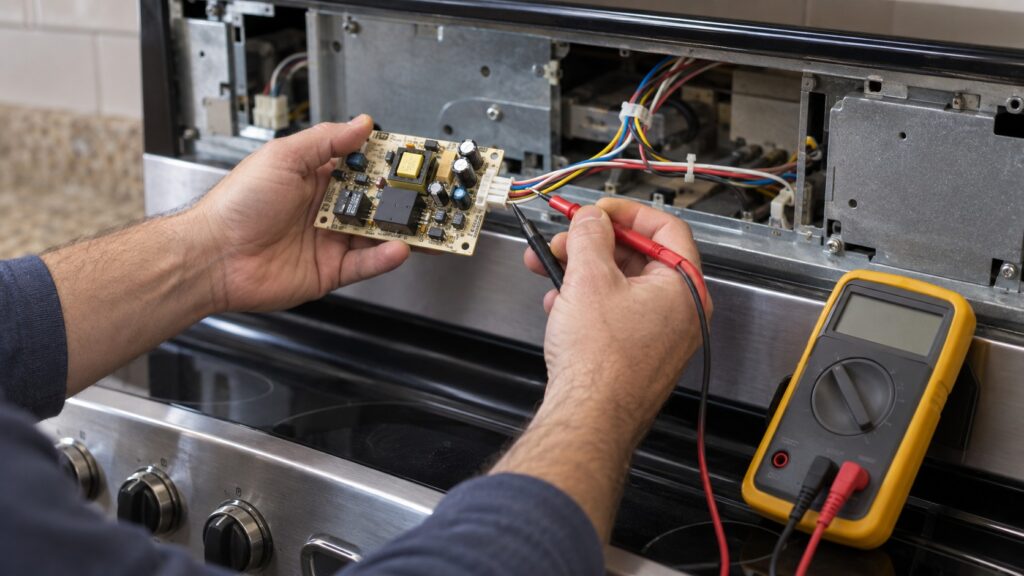
Both are common causes, and the fix is very different depending on which one it is. A loose or corroded connector between the two boards produces exactly the same code as a board that has actually failed internally, which is why a technician tests the connection itself — continuity across the harness pins — before ordering either board. A connector fault is a comparatively inexpensive repair; a failed analog board is a costlier part, though still a targeted repair rather than a reason to replace the whole range on its own. Testing for continuity across the harness before ordering a board is the step that keeps a repair from turning into an expensive guess — a board ordered on assumption, when the real fault was a corroded pin, is a wasted part and a second visit.
How much does an analog board repair typically cost relative to the range?
A control-board repair on a mid-range or upper-range Jenn-Air model runs from a modest diagnostic-and-connector fix on the low end to a full board replacement plus labor on the high end. Either way, the repair cost on its own is usually a fraction of what a comparable replacement range would cost, which is the main reason a single F8-E0 fault is not, by itself, a reason to replace the appliance. Pricing depends on the specific model and whether the part is the analog board, the digital board, or just the connecting harness — a diagnostic visit is what narrows that down before any number is quoted.
When does F8-E0 start pointing toward replacement instead of repair?
The decision shifts toward replacement when F8-E0 shows up alongside other signs the range’s electronics are aging out together — a range that has already had one control-board or relay repair in the past year or two, one that is well past ten years old, or one where a second unrelated fault appears within weeks of the first being fixed. None of those signs come from the F8-E0 code itself; they come from the pattern of faults around it. A single, isolated F8-E0 on an otherwise reliable range is a repair, not a replacement decision. The same range with a five-year-old control-board repair already on file, now showing a second unrelated fault, is telling a different story than its first F8-E0 code ever did on its own.
Does F8-E0 affect the oven only, or the whole range?
Because the analog and digital boards typically manage both the cooktop’s ignition and sensor functions and the oven’s, a communication fault between them can affect either side or both, depending on which functions route through the broken link. A range showing F8-E0 with only the oven locked out and burners still working normally has a narrower fault than one where nothing on the range responds at all — that distinction is useful information for the technician diagnosing the connector versus board question above.
What should be checked before assuming the boards themselves have failed?
A power cycle — disconnecting the range at the breaker for a couple of minutes and restoring power — occasionally clears a transient communication fault without any parts being replaced, though a fault that returns immediately after power is restored is reporting something ongoing rather than a fluke. Worth noting before that reset: writing down whether the fault appeared after a power outage, a storm, or an install, since a fault tied to one of those events points at a jarred connector rather than a board that is failing on its own. Beyond that, this is not a fault a homeowner can safely diagnose further without opening the control compartment, which sits close to line-voltage connections and is not designed for casual access. Range burner or oven not working covers the broader troubleshooting picture if other symptoms are showing up alongside the code.
How does this compare with other range control decisions on this site?
This is a narrower, code-specific version of the broader question covered in range repair or replace, which walks through the full range of factors — age, repair history, and cost — for a range with any kind of fault. F8-E0 slots into that same framework as one specific data point: a control-board communication fault that is a repair on its own, and a replacement consideration only in combination with everything else already known about the range’s condition. Reading both guides together gives a fuller picture than either one does alone, since the code narrows the diagnosis and the broader guide frames the decision once the diagnosis is known.
We are an independent repair company, not a factory service arm, and we will tell you when a repair is not worth doing. Pricing starts from a diagnostic visit and we confirm the estimate before any work begins. Jenn-Air range repair covers F8-E0 diagnosis, and you can schedule a visit to get a straight answer on whether this range is worth repairing.