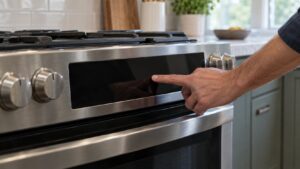
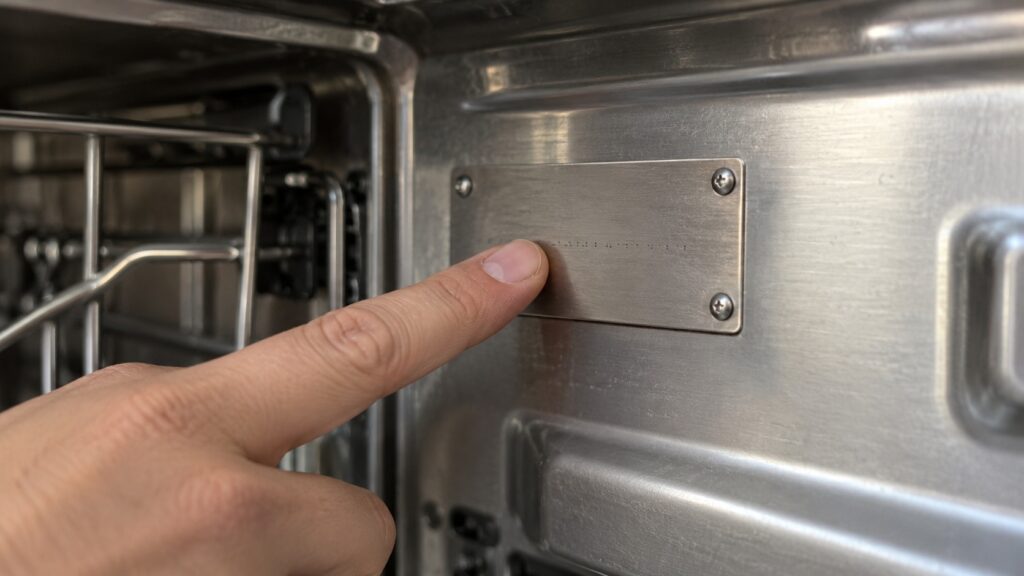
A Jenn-Air model number is the single most useful thing to have in hand before you call for service, and it starts with letters that name the kind of appliance: JJW is a wall oven, JGC is a gas cooktop and JMW is a microwave and oven combination, as our feature glossary lists them. What the letters at the end of the number mean is a different matter, and we do not decode them here, because we have no factory table that confirms any single-letter meaning. This guide covers what the beginning of the number tells you, what the digits are not safe to assume, where the rating plate is on each appliance, how to record the number correctly and how to tell it from the serial number.
What does the start of a Jenn-Air model number tell you?
The first letters name the product family. Our feature names glossary says a JJW number is a wall oven, a JGC number is a gas cooktop and a JMW number is a microwave-and-oven combination, and that the digits that follow give the size and the style of the model. That is as far as we go. Jenn-Air uses many other prefixes for refrigerators, dishwashers, ranges and wine cellars, and we do not claim to know what every individual letter stands for. When a prefix is not one of the three above, treat the whole number as a code to be looked up, not read.
Knowing the family still helps. It tells you which of our repair pages to start from and which part of the house the appliance belongs to when you describe it on the phone. A wall oven and a cooktop with similar numbers are different appliances with different faults, so the first letters are worth reading aloud first.
Can you read the size from the digits?
Often the digits that follow the prefix hint at the width of the appliance, but the hint does not hold for every number, and we will not give you a rule. Check the width and the cutout dimensions in the specification sheet or the owner’s manual for the exact model, especially before you order a replacement or plan an opening. Guessing the size from digits is how the wrong part or the wrong panel ends up on a doorstep.
Why the letters at the end are not decoded here
The last letters of a model number often separate versions of the same appliance: a different finish, a different design expression or a different configuration. A guess that is right for one family can be wrong for the next, and a wrong guess can send you to order a part in the wrong finish. For that reason the safe approach is to treat the ending as part of the number and to copy it exactly, every letter, with no assumptions. If you want to know what your own ending means, the owner’s manual and the specification sheet for your exact model are the sources. Our guide to choosing Rise or Noir and our panel-ready glossary explain the design vocabulary in general terms.
Why does it matter? Trim, glass and handles can differ between versions even when the heating or washing parts are the same, so a part that fits one version may not suit another. The full number settles it, and a technician can confirm it against the appliance on a visit.
Where do you find the model number, and what is the serial number?
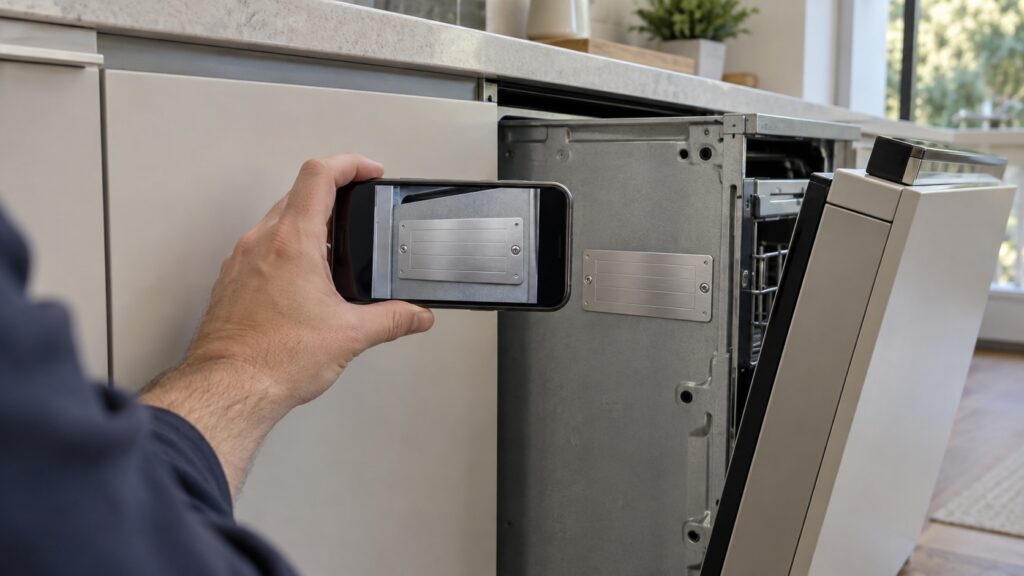
The rating plate carries both. Our glossary lists where to look: inside the door frame on an oven, under the lid or on the underside of a cooktop, on the inner wall of a refrigerator and on the door edge of a dishwasher. Photograph it once and keep the photo. The serial number is a separate string on the same plate and it is not the model number, so a search that uses a serial number alone, such as a long number from a refrigerator plate, will not tell you the model. We do not decode serial numbers here because we have no source for them; use the model number, and give the serial number to a technician when asked.
If the plate is missing or unreadable, look in the owner’s manual, the purchase paperwork or the original installation sheet. Do not remove an appliance from its cabinet or open a cabinet to look for a plate, and do not pull a built-in appliance forward on your own; a built-in unit can be heavy and connected to power or gas behind it. If you need help identifying the appliance, our technicians can find the plate on a visit: book a visit. We are an independent repair company, not a factory service arm.
How do you write the number down so it is not misread?
Copy every character in order, in capitals, and read it back once. Letters and digits that look alike are the usual source of mistakes, so a photograph of the plate is better than a handwritten note. Keep the photo with your receipt or installation sheet so the number is there the next time you need a part, a manual or a visit. When you phone for service, say the number slowly and spell the letters one at a time.
How do you use the model number when you need service?
Give the full number with every letter. It lets a technician bring the right part and tells our site which codes and guides apply. For the wider vocabulary, see cooking appliance terms and refrigeration terms. For a range or other appliance that needs attention, start from our Jenn-Air range repair page.