TL;DR: Three codes on our site point at the Jenn-Air wall oven control board itself: F1-E0, where the board cannot access its memory, F5-E0, where the safety watchdog circuit detects a hardware conflict, and F8-E0, where the main board and a secondary board stop communicating. In each case the board is a modular, replaceable part, so a sound oven is usually worth repairing. Replacing the whole oven is worth considering only when it is old and other major parts are also failing.
What does a Jenn-Air wall oven control board do?
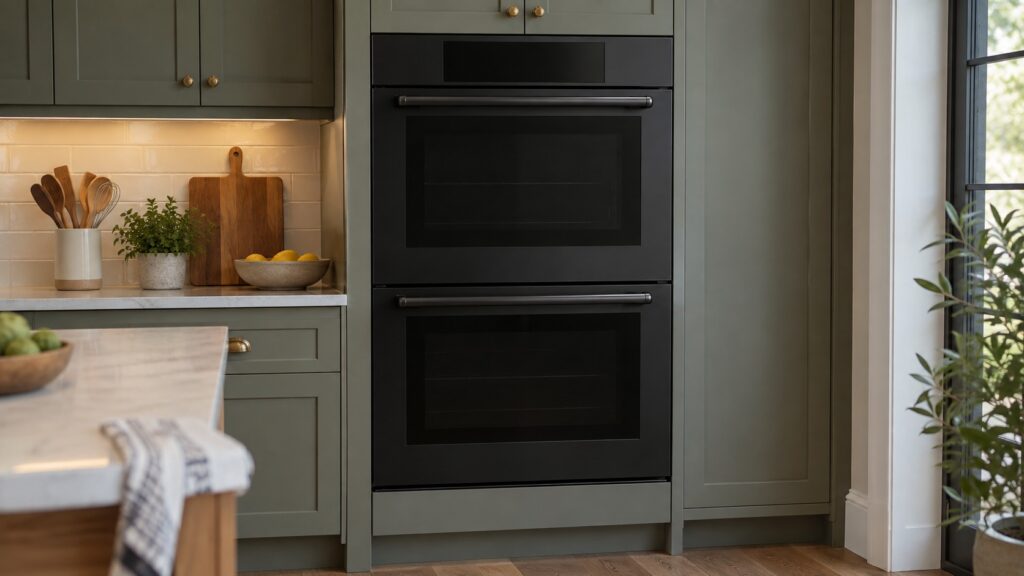
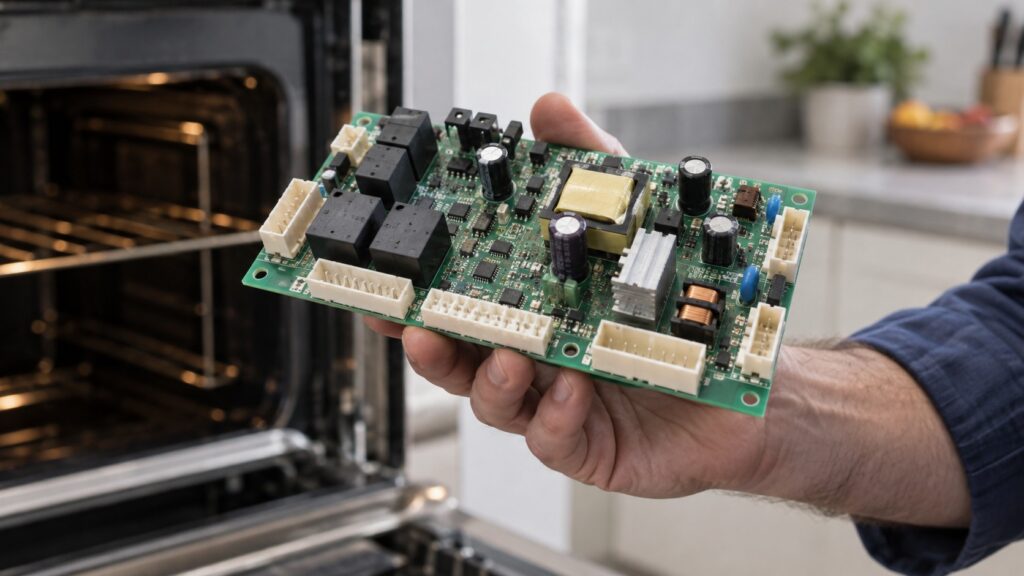
The electronic oven control board is the brain of the oven. It reads the keypad and the temperature sensors, decides when to switch the bake and broil elements on and off through relays, runs the convection fan and the door lock, and keeps your settings. On a double oven such as the NOIR JJW2830IM with its MultiMode convection system, the main board often works alongside a secondary relay or interface board, and the two must keep talking for the oven to run safely.
That is why a board fault looks dramatic: the oven may not heat, may not respond to the display or may refuse to start any cycle at all. It does not mean the heating elements, the cavity or the door have failed. The thing that failed is usually a single module that is built to be swapped.
Which codes point at the board and what do they mean?
F1-E0 says the control board cannot reach its EEPROM, the memory chip that holds settings and calibration. The oven may not operate, and a power cycle may clear it only until the next time. F5-E0 says the safety watchdog circuit has found the processor and its monitor in conflict; the watchdog exists to prevent unsafe operation if the main processor malfunctions. F8-E0 says the main board and a secondary board are not communicating, which can come from a failed relay board, a broken harness or a fault in the main board’s communication circuitry.
Several of these showing up together is the strongest sign of a failing board. If you have any of them, write down every code you see, before and after a reset, because the pattern helps a technician decide.
What should be ruled out before a board is blamed?
Boards are expensive enough that guesswork is costly, so a good technician checks the cheaper causes first. Power quality is one. The F5-E0 page points to unstable supply voltage as a cause, and a circuit shared with other appliances or a loose connection at the junction box can trip the watchdog. A harness with corroded or loose connectors can produce the F8-E0 communication fault, and a surge can damage the memory subsystem and produce F1-E0.
The owner-level step is a power cycle: switch the oven’s breaker off for several minutes, then restore power. If a glitch caused the code, the oven recovers. If it returns, the cause is real. Please do not open the oven’s wiring compartment; it carries 240 volts and the parts are not user-serviceable.
When is repair the right call?
Repair makes sense when the oven is otherwise in good shape: the cavity is sound, the door seals, the elements heat and the finish has held up. Control systems on these ovens are modular on purpose, so a single failed board, relay board or harness can be replaced without touching the rest. That keeps a built-in oven in its cabinet, which avoids the larger cost and disruption of removing it, fitting a new one, and sometimes modifying the cabinet. Our general oven repair or replace guide gives the wider rules, and the same logic shows up in our note on the range F8-E0 decision.
Be aware that a code is not a quote. The price of a board repair depends on which board is involved and what the technician finds, so ask for the finding and an estimate before work begins. A single board often costs less than people fear, compared with replacing a premium wall oven.
When does replacing the oven start to make sense?
Replacement becomes reasonable when the board fault is one of several problems: a door that no longer seals, elements that are burning out, a cavity that is damaged or a unit that has repeated electrical faults. Age also matters. A wall oven that has had many years of heavy use is statistically closer to its next failure than a lightly used one. If you are weighing it, our downdraft ventilation repair or replace guide is another worked example of weighing repair against replacement, and the wall oven configurations guide helps if you decide to buy again.
If the oven is a lock fault rather than a board fault, see oven door lock codes. Otherwise, our Jenn-Air oven repair technicians can test the board and the parts around it, and you can book a visit with the codes you recorded.