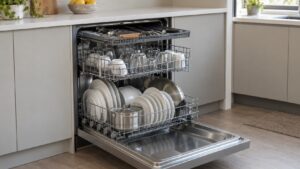
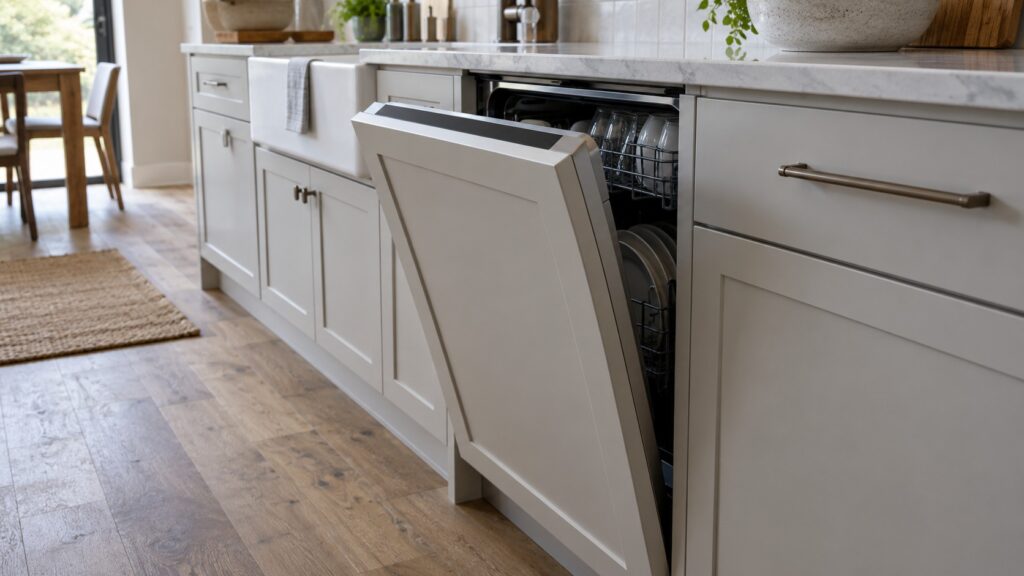
A Jenn-Air dishwasher control board fault is usually worth repairing. The board is a replaceable part, and the rest of a well-built integrated dishwasher, the tub, racks, pumps and door, typically outlasts it. Replacing the whole dishwasher starts to make sense only when the electronics are one of several failing systems, when the machine is old, or when the board failed because of water damage from a leak that has also hurt other parts. Identify which electronic fault you have first, because three different codes point at three different boards.
What does the control board do in a Jenn-Air dishwasher?
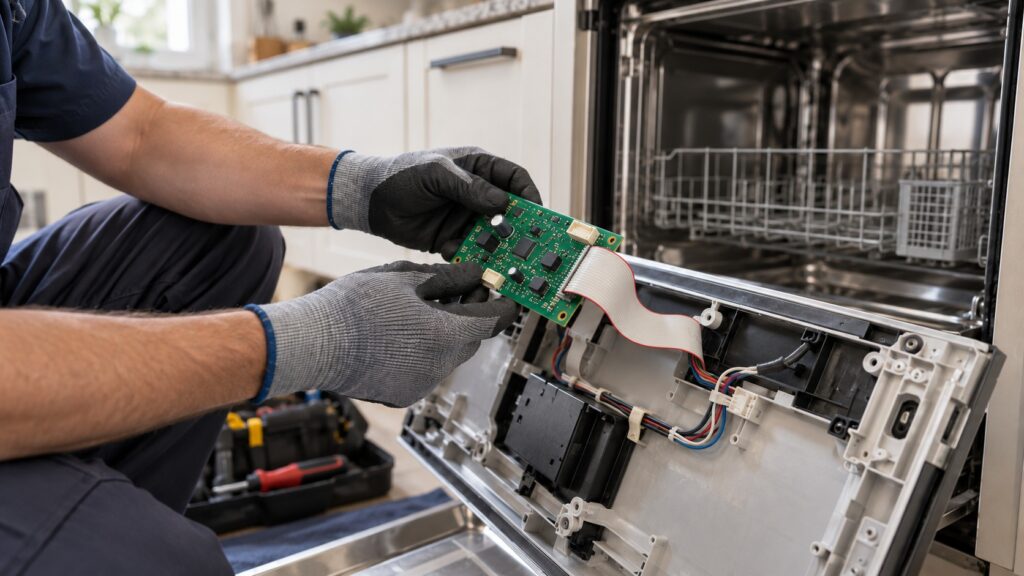
The control board is the dishwasher’s brain. It reads the door switch, the water temperature sensor and the turbidity sensor, and it decides when to fill, wash, heat, drain and dry. Many Jenn-Air dishwashers also have a separate board for the motor and a user interface at the front with the touch controls. When one of them fails, the dishwasher can refuse to start, stop in the middle of a cycle, behave randomly or throw a code.
Because the board is a plug-in electronic module and not part of the tub or the wash system, replacing it does not mean replacing the machine. That is the main reason repair is the usual answer, and it is especially true for fully integrated models, which are costly to fit and trim.
Why do dishwasher control boards fail?
Boards rarely wear out from use. They fail because of the environment they sit in. Moisture is the main enemy: a slow leak at the door seal, the inlet valve or a hose can drip onto the electronics, and steam during the drying phase can settle on them over the years. Voltage surges and brownouts are the second cause, which is why a fault often appears right after a storm. Heat plays a part too, since the board sits near the tub and the heating element. Knowing the cause helps you decide: a board that failed from a surge is a clean repair, while one that failed from a leak means you should find and fix the leak as well.
How do you tell a board fault from another problem?
Several symptoms look like a bad board but come from other parts. The code is the best guide.
- Board faults: F1-E1 for the control board, F1-E2 for the motor board and F2-E1 for a stuck user interface. See our pages on F1-E1, F1-E2 and F2-E1.
- Not a board fault: F5-E1 is a door switch failure, F9-E1 is a drain pump issue, F8-E1 is a slow drain, F6-E1 is a water inlet valve failure and F7-E1 is a heating element failure. A new board will not fix any of them.
- Ambiguous: a dishwasher that is completely dead, with no lights and no response, may have a board problem, a blown fuse or a supply issue. Check the breaker first.
Our guide to a dishwasher not draining is a good example of how much of what looks like a board problem is really a pump or a blockage.
What can you check before you decide?
A little investigation changes the picture and protects you from replacing the wrong part:
- Power cycle it. Switch the dishwasher off at the breaker for about five minutes, then restore power. A one-time glitch can clear.
- Look for a leak. Check the floor and the base of the cabinet for moisture. A leak that reached the electronics is the one case where replacement can win, because water damage rarely stops at one board.
- Check the touch panel. Wipe the control area dry. Moisture or a film of residue can make a key read as pressed, which is how a stuck user interface starts.
- Note the age and history. A dishwasher with its first fault is a good repair candidate. One that has needed the pump, the valve and the board in a short time is a worse one.
Do not open the control panel yourself. The door panel and the control area sit close to mains wiring and to water, and integrated models are fitted with custom panels that are easy to damage.
When does replacing the whole dishwasher make sense?
Replacement is the right call in a few clear situations. The machine is old and several systems are wearing out, so you are paying to fix one while others are about to fail. The board failed because of a leak that damaged the cabinet wiring or other boards. A needed part cannot be sourced. Or you want a different feature set, such as a quieter model or a third rack with wash. Check the Jenn-Air dishwasher repair or replace guide for the full decision and our JDPSS245LX buying guide if you are choosing a successor.
Replacing a panel-ready or fully integrated dishwasher is more work than swapping a freestanding one, because the custom door panel, the hidden controls and the cabinet cutout all have to match. Our panel-ready glossary explains why a panel-ready machine makes a swap more involved.
What should you ask a technician?
Ask which board has failed and how the technician confirmed it, whether the part is available for your exact model, whether anything else is close to failing and what the labor warranty covers. A good diagnosis names the part and the evidence for it. Our Jenn-Air dishwasher repair technicians test before they replace and give you a straight recommendation. We are an independent repair company, not a factory service arm, and we will tell you when a repair is not worth doing. You can book a visit and bring the code.