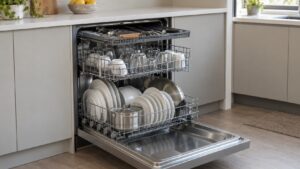
Jenn-Air’s dishwasher lineup is built around a single defining idea: three wash zones working independently instead of one spray arm doing everything. That design, branded TriFecta, is the reason Jenn-Air dishwashers clean differently from a typical single-arm unit, and it shapes how they fail, too.
Understanding the Jenn-Air Dishwashers
Below, our specialists break down everything you need to know about the Jenn-Air Dishwashers.
The TriFecta wash system and lineup
Rather than one pump feeding a single rotating arm, the TriFecta system splits wash water across three coordinated zones tuned for different item types — tall stemware and pots in one zone, everyday plates and bowls in the main zone, and utensils or small items in a dedicated third rack up top. Jenn-Air offers this system across both panel-ready models, which hide behind custom cabinetry, and fully integrated stainless models in the RISE, NOIR, and Euro-Style lines.
- Three independently targeted wash zones per cycle
- Dedicated third rack with its own spray jets for utensils and small items
- Panel-ready and stainless finish options
- Quiet-operation sound insulation on most models
Signature technologies
Beyond the TriFecta zones, Jenn-Air dishwashers use sensor-based soil detection to adjust cycle length and water temperature to the load, and most models include a heated dry option that relies on a dedicated heating element rather than passive air drying. The third rack sits above the main tub and draws water through its own supply line, which is a mechanically separate system from the lower racks.
Sound insulation packages on most models layer foam and dampening material around the tub and pump housing, which is why a well-functioning Jenn-Air dishwasher runs noticeably quieter than older single-zone designs — and why an unusual grinding or knocking noise is worth investigating early rather than dismissing as normal operation.
Common problems and reliability
Because the wash system has three semi-independent zones, a single failed spray jet, clogged filter, or weak zone pump tends to produce partial-cleaning complaints rather than a total wash failure — which can make the problem harder to notice until it’s been happening for a while. Drain pumps and water inlet valves are the other common wear points, particularly in hard-water areas where mineral buildup accelerates valve failure. Control board issues are less frequent but show up as a frozen or unresponsive display. For symptom-specific detail, our error code reference covers what each error code means, and dishwasher repair is available when a professional diagnosis is needed.
Door latch and switch assemblies also see steady wear on any dishwasher that runs daily, since they cycle mechanically every time the door opens and closes. A latch that’s slightly out of alignment can prevent a cycle from starting even when the dishwasher itself is otherwise fully functional. Heating elements used for the dry cycle also see gradual wear from mineral scale buildup in hard-water regions, which is one more reason routine descaling matters beyond just glassware clarity. Flow meters that measure water intake for the inlet valve can drift out of calibration over years of use, producing fill timing issues that look like a valve problem at first glance.
Maintenance tips
Clean the fine filter at the bottom of the tub every few weeks — a clogged filter is the single most common cause of cloudy glassware and slow drainage, and it’s a five-minute fix. Run a monthly cleaning cycle with a dishwasher-safe descaler if you’re in a hard-water area, since mineral scale is what eventually kills water inlet valves. Load large items so they don’t block the third rack’s spray jets, which are easy to obstruct given their small size. Inspect the door gasket occasionally for food debris or wear, since a gasket that isn’t sealing properly can let water escape during the wash cycle. Rinse heavily soiled dishes before loading if you notice cleaning performance dropping, since excess solid food waste is the fastest way to overload the filter and drain system between cleanings. Jenn-Air’s manufacturer site at jennair.com lists care instructions per model, and our models page tracks the units our technicians have parts on hand for.