This overview covers Jenn-Air Wine Coolers — the lineup, signature technologies, common problems, and upkeep.
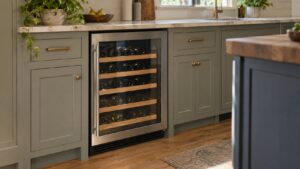
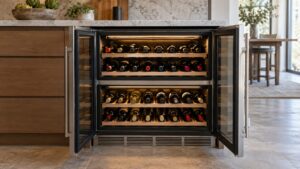
Jenn-Air’s wine cooler lineup centers on the dual-zone wine column, a full-height built-in unit designed to hold two different storage temperatures in the same cabinet — one for whites and sparkling wines, another for reds — alongside smaller under-counter options for secondary storage or bar areas.
Understanding the Jenn-Air Wine Coolers
Below, our specialists break down everything you need to know about the Jenn-Air Wine Coolers.
The wine cooler lineup
Dual-zone wine columns are the flagship format, built to install alongside matching refrigerator and freezer columns in a coordinated kitchen wall, while under-counter and built-in wine coolers offer a more compact option for bars, media rooms, or secondary kitchens. Both formats are available across the RISE and NOIR design lines, and both share the same core dual-zone concept even though the wine column obviously holds significantly more bottles across its taller cabinet. Shelving in both formats is typically designed to slide out for easy access and sized to accommodate standard bottle shapes without excessive wasted space. Interior lighting is usually LED and low-heat by design, since any added heat source inside the cabinet works directly against the compressor and fan system trying to maintain a stable temperature, and reducing internal heat load anywhere possible helps both zones run more efficiently over the appliance’s life. That attention to detail across lighting, shelving, and door seals is what distinguishes purpose-built wine storage from simply repurposing a small refrigerator, and it’s also why diagnosing a problem correctly matters more here than on a typical kitchen appliance, since a wrong guess risks the collection itself rather than just an inconvenience.
- Full-height dual-zone wine columns
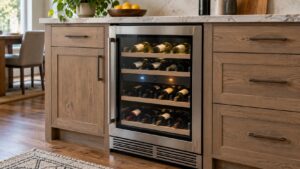
- Under-counter wine cooler options
- Built-in installation with panel-ready fronts on select models
- UV-filtered glass doors to protect bottles from light exposure
Signature technologies
Each zone in a dual-zone unit runs its own temperature sensor and, on most models, its own circulation fan, allowing the two compartments to be held several degrees apart from each other reliably — a meaningfully more complex design than a single-zone cooler. UV-filtered glass doors reduce light exposure to stored bottles, addressing one of the more overlooked factors in long-term wine storage alongside temperature and humidity.
Vibration control is another quieter design priority in wine storage, since excessive vibration is known to disturb sediment in aging red wines over time. Compressor mounting and fan balance are engineered with that in mind, more so than in a general-purpose kitchen refrigerator.
Common problems and reliability
Because the two zones operate semi-independently, problems tend to be zone-specific — a failed sensor or fan in one zone rarely affects the other, which is a useful diagnostic signal but also means a problem can go unnoticed in a rarely-opened zone for longer than it would in a single-zone unit. Compressor and cooling circuit failures are less common but more serious, since they can affect both zones depending on how the unit’s refrigeration circuit is configured. Our error code guide covers what each error code indicates, and wine cooler repair is available when a zone won’t hold its set temperature.
Door seal wear is a slower-developing issue that’s easy to miss, since a gasket rarely fails all at once — it loses its seal gradually, which shows up first as a slight temperature drift rather than an outright alarm.
Maintenance tips
Check door seals periodically, since a leaking seal is one of the most common causes of a zone drifting out of range gradually rather than failing outright. Avoid opening the door frequently or leaving it open for extended periods, since that’s the fastest way to trigger temperature swings in a compact cabinet. Keep the unit’s ventilation area clear of obstructions to help the compressor and fans run efficiently. If you notice one zone drifting even slightly from its set point, address it early rather than waiting for a full alarm, since catching a fan or sensor failure before it worsens is far simpler than a full compressor diagnosis later. Jenn-Air’s manufacturer site at jennair.com has model-specific specifications, and our models reference tracks units our technicians regularly service.