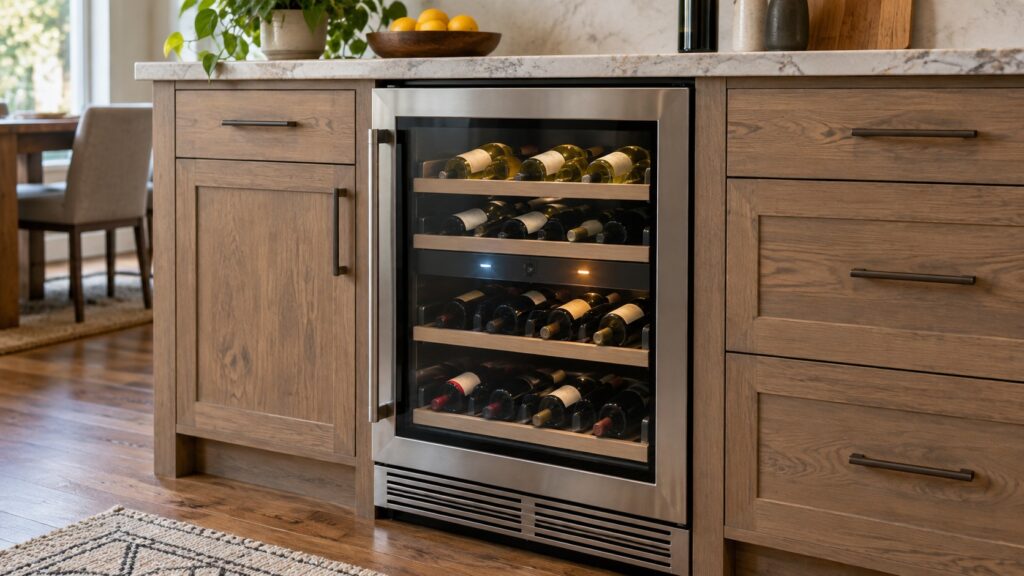
Jenn-Air wine cooler error codes split into three groups, and knowing which group you are looking at decides everything that follows. E1 and E2 name a failed zone sensor. LO, HI and OD are alarms about conditions, not broken parts. FN, CO and DF describe the cooling hardware itself. On the 24-inch built-in undercounter cellars — the JUWFL and JUWFR 242H models, left and right swing — each of the two zones has its own sensor and its own display digit, so the code tells you not just what is wrong but which half of the cabinet is reporting it.
What do E1 and E2 mean on a Jenn-Air wine cooler?
E1 is an upper zone sensor failure and E2 is a lower zone sensor failure. They are the same fault in two places, and the pairing is the most useful thing about them: a cellar that shows one and not the other has a component problem, while a cellar that shows both at once usually has a wiring or board problem, because two independent sensors rarely die the same night.
A failed zone sensor does not necessarily stop the cabinet from cooling. Depending on where in its range the sensor quit, the affected zone may hold roughly the right temperature, drift several degrees, or run to one extreme. What it cannot do is respond to the setpoint, so a zone with an E1 code that still feels cold is not fixed — it is unregulated, and a collection stored at an unregulated temperature is at risk in a way the display is no longer able to warn you about.
Are LO and HI faults or warnings?
They are warnings, and they are the codes most worth acting on immediately even though nothing is broken yet. LO means a zone has fallen below its safe band; HI means it has climbed above. Both describe where the wine is right now, not what failed.
The honest reading is that an alarm code is the cellar doing its job. A HI alarm after a party, after a long door-open spell or on the hottest afternoon of the year is the unit telling you it could not keep up, and it will usually clear itself within a few hours. A LO alarm on a zone set near the low end of its range often means the setpoint is simply too aggressive for the ambient conditions in the cabinet run.
What turns an alarm into a fault is repetition. A HI alarm that comes back every evening, or a LO alarm that will not clear at a moderate setpoint, has stopped being a condition report and become a symptom — usually of the fan, the door seal or the sensor behind it.
Why does my cellar show OD when the door is closed?
OD means the door was open too long. On a built-in undercounter cellar the common cause is not a door left ajar but a door that never fully seated: a bottle protruding from the top shelf, a rack pushed forward, or a custom panel adjusted so the magnetic seal does not close on the frame.
Check three things in order. Run a hand around the gasket for a cold draft along the hinge side. Look for a bottle neck or a shelf rail standing proud of the rack line. Then open and firmly close the door and confirm the interior light goes out. A light that stays on says the door switch is not registering closure, and the cellar will keep counting door-open time forever.
Left-swing and right-swing versions of the same model are installed as mirror images, so a cellar that has been swapped into a different cabinet opening sometimes ends up with the door sweeping into a wall return and never quite latching. That is a hinge-side installation issue rather than an appliance fault.
What do FN, CO and DF say about the cooling side?
These three describe the machinery, and they escalate in seriousness from left to right.
- FN — fan motor failure. The compressor may be running perfectly, but without circulation the cold sits at the evaporator. The giveaway is a cabinet where one shelf is notably colder than the rest and the unit runs almost continuously.
- CO — cooling system problem. This is the refrigeration circuit itself, and it covers everything from a compressor that will not start to a sealed-system loss. A cellar showing CO will not hold temperature at any setpoint.
- DF — defrost system error. Frost is building where it should be cleared. Early on this looks like a cellar that runs longer than it used to; left alone it turns into a cabinet that cannot cool at all, because the ice blocks airflow across the evaporator.
FN and DF often appear together, for a simple mechanical reason: when the fan stops, moist air stops moving, and frost forms on a cold surface that is no longer being swept.
Does PF mean the wine was affected?
PF only reports that the unit lost and regained power. It says nothing about how long the outage lasted, which is exactly why it is worth treating as a prompt rather than a notice. A full cabinet of bottles holds temperature for hours; a lightly loaded cellar in a warm kitchen does not.
Clear PF by acknowledging it at the panel, then check both zone temperatures against their setpoints over the next few hours. If a zone comes back to setpoint and stays there, you are done. If PF is followed by an E1, E2 or CO code, the power event may have taken a component with it, and the second code is the one to act on.
Which of these can I clear myself?
Four of the nine are within reach without tools:
- OD — reseat the bottles and the racks, confirm the seal and the door switch.
- PF — acknowledge, then watch both zones for a few hours.
- HI after a known cause — give the cellar time with the door closed and a moderate setpoint.
- LO on an aggressive setting — raise the setpoint a few degrees and let both zones settle overnight.
The remaining five — E1, E2, FN, CO and DF — all sit behind the interior rear panel or under the unit, where the sealed system, the fan wiring and the defrost circuit live. A built-in cellar is also trimmed into cabinetry and vents through its own front grille, so pulling it for rear access is not a casual job. Stop there. Our guide on a cellar that will not hold temperature covers the symptom side when no code is showing at all.
When does a code become a service call?
Book service when a sensor code appears, when a cooling-side code appears, or when an alarm keeps returning after you have addressed the obvious cause. Note which zone the code belongs to, the setpoints for both zones, the model number from the inner frame sticker, and whether the cabinet is left or right swing — on a built-in, that determines how the unit comes out.
We are an independent repair company, not a factory service arm, and with a cellar full of bottles we will say honestly whether a repair or a temporary relocation of the collection is the better first move. Pricing starts from a diagnostic visit and we confirm the estimate before any work begins. Jenn-Air wine cooler repair covers the sensors, the fan and the sealed system described here, and you can schedule a visit with the code and both zone readings written down. If you are weighing a replacement instead, our sizing guide covers what a 24-inch undercounter cabinet actually holds.