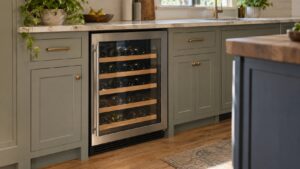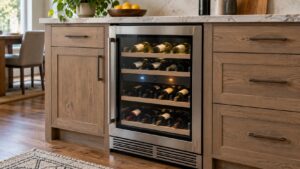
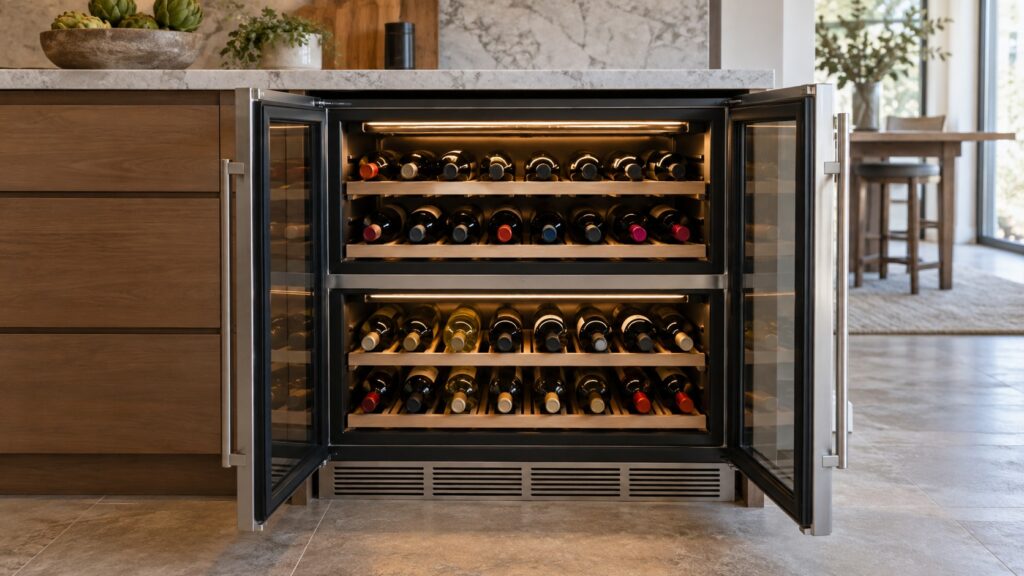
How Jenn-Air wine cellar dual-zone cooling works comes down to one cabinet split into two sealed compartments, each with its own temperature sensor and its own airflow path, so the upper zone can run several degrees warmer for reds while the lower zone holds a colder setting for whites and sparkling wine — without one zone’s air ever mixing with the other’s.
What makes dual-zone cooling different from a single compressor running two thermostats?
The difference is not just two thermostats bolted onto one cooling loop — it is two independent air circuits inside one cabinet, physically separated by an insulated divider. Each zone has its own temperature sensor reporting back to the control board, and each zone draws cold air through its own duct path rather than sharing a single airflow that gets throttled up and down. That separation is what lets one zone sit at a red-wine service temperature while the other holds a white-wine chill only a few inches away, with no shared air current pulling the two toward each other.
A single-zone cellar with a smart thermostat could, in theory, alternate between two setpoints over time, but it could never hold two different temperatures at the same moment in two parts of the same cabinet. That constant, simultaneous split is the entire point of a dual-zone design, and it is why the hardware inside is meaningfully more complex than a single-zone unit rather than just a software difference layered on the same parts.
How does the compressor serve two different temperatures at once?
Most dual-zone under-counter wine cellars use a single compressor and evaporator, with a system of dampers or a secondary fan controlling how much cold air reaches each zone independently. When the lower zone’s sensor calls for more cooling, its damper opens further and its fan draws more of the available cold air; the upper zone’s damper and fan run on a separate schedule tied to its own, warmer setpoint. The compressor itself does not run two different temperatures — it produces one supply of cold air, and the zone dampers meter how much of it each compartment gets.
Why does the divider between zones matter so much?
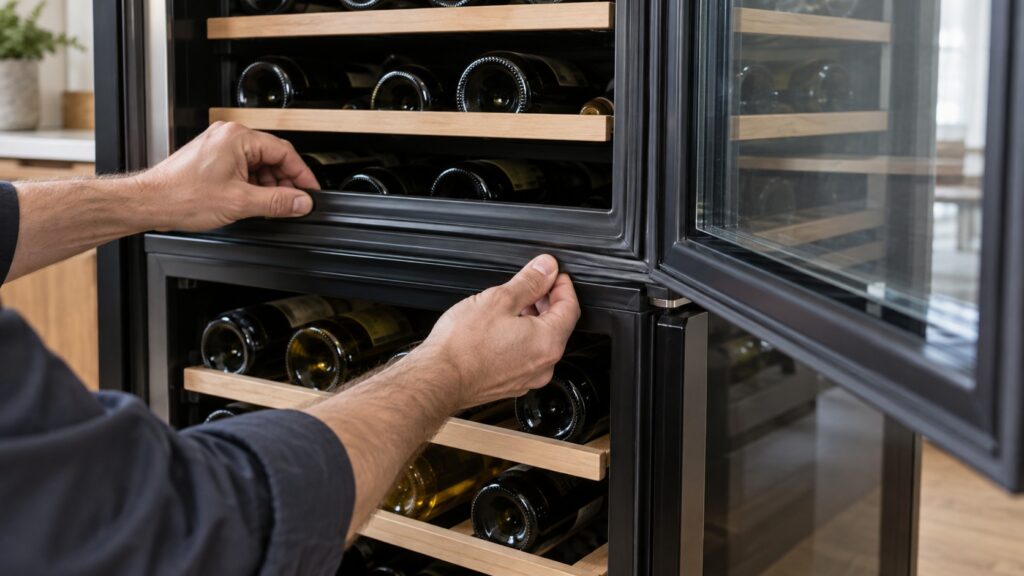
The insulated divider is what keeps the warmer zone from simply drawing cold from the colder one through shared air. Without a well-sealed divider and its own door gasket on each compartment, the two zones would slowly average toward the same temperature every time either door opened, defeating the reason to buy a dual-zone unit in the first place. A worn or damaged divider seal is also one of the more common reasons a dual-zone cellar starts drifting — the upper zone creeping colder than its setpoint as it pulls conditioned air meant for the lower one.
Does door swing direction affect how dual-zone cooling performs?
Jenn-Air’s under-counter wine cellars ship in both left-hinge and right-hinge versions of the same dual-zone cabinet, which matters for kitchen layout but not for how the two zones cool. What does matter for performance is how often and how long either door stays open — every opening lets in warm room air that both zones then have to remove, and the zone nearer the door recovers first simply because it is closer to the cold-air outlet. Choosing the hinge side that lets the door open fully without a cabinet or island in the way reduces how long each opening leaves a zone exposed. Since both zones sit behind the same door on most under-counter models, a longer open-door moment costs both zones recovery time at once, not just whichever zone happens to be nearer the opening.
What happens if only one zone stops holding temperature?
Because the two zones run on separate dampers and sensors off one shared compressor, a fault in a single zone’s damper motor or sensor typically affects only that zone while the other continues to hold its own setpoint normally. That is a useful diagnostic signal: if both zones drift together, the shared compressor or the main control board is the more likely cause; if only one zone drifts, the fault is probably isolated to that zone’s damper, fan, or sensor. Wine cooler not cooling properly walks through both patterns in more detail.
How does dual-zone cooling show up on the control panel and error codes?
A dual-zone cellar’s control panel typically displays and lets the user set each zone independently, and its fault codes are written the same way — a temperature alarm or sensor fault on this site’s error-code list for wine cellars can specify which zone triggered it rather than treating the cabinet as one unit. Reading which zone a code refers to narrows a diagnosis considerably compared with a single-zone unit, where there is only one zone it could be.
Is dual-zone cooling worth choosing over a single-zone wine cellar?
Dual-zone makes the most sense for a household that actually stores both reds and whites long enough to want each at its correct service temperature rather than one compromise setting. A single-zone unit is simpler, has fewer parts that can fail independently, and suits a collection that leans toward one wine style. The added dampers, second sensor, and divider seal in a dual-zone cabinet are also the added parts a technician has to check first when something does go wrong, so the convenience of two temperatures comes with a slightly longer list of components that can eventually need attention. Sizing a wine cellar covers capacity planning for either configuration once the single-zone-versus-dual-zone decision is made.
We are an independent repair company, not a factory service arm, and we will tell you when a repair is not worth doing. Pricing starts from a diagnostic visit and we confirm the estimate before any work begins. Jenn-Air wine cooler repair covers dual-zone units and single-zone units alike, and you can schedule a visit if one zone has stopped holding its setpoint.