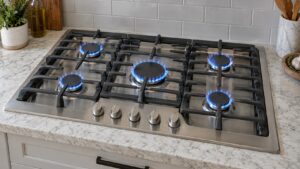
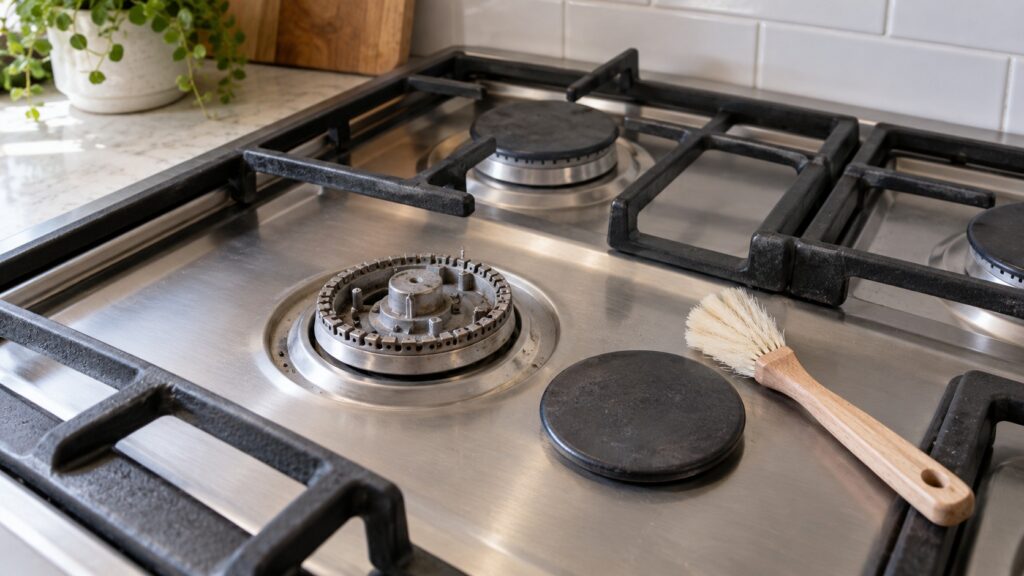
To clean the burners on a Jenn-Air gas cooktop, switch every burner off and let them cool completely, lift off the grates and burner caps, brush out the ports on the burner head, wipe the caps and the area around the igniter, let everything dry fully and set each cap back squarely. Doing this regularly keeps the flame even and the ignition reliable. This Jenn-Air gas cooktop burner cleaning guide covers the sealed burners and the PowerBurner on models such as the JGC3536GS, JGC7530BS, JGC7636BS and JGC3215GS, explains what a dirty burner looks like in use and shows when cleaning is not enough and a technician should look at it.
How often should you clean a Jenn-Air gas burner?
Wipe up spills as soon as the cooktop is cool, and do a full burner clean when the flame looks uneven or after a boil-over, and on the schedule your owner’s manual suggests, because dried food in the ports is the main cause of a flame that is uneven or slow to light. A kitchen that fries or simmers sauces daily needs it more often than one that boils water. Our cooktop maintenance guide covers the surface and the controls, and this guide is the burner routine in detail.
It also helps to know what a dirty burner looks like while you cook. A flame that is shorter on one side, a burner that takes several clicks to light, a flame that lifts away from the head or a burner that will not hold a low setting are all signs that debris is in the ports or that a cap is not seated. Look at the flame in a dim kitchen before you clean, so that you can compare afterward. If the flame improves, the cleaning worked and nothing else needs doing. If it does not, write down which burner and what the flame does, because that detail helps a technician.
What do you need, and what should you avoid?
- A soft brush, such as an old toothbrush, and a soft cloth.
- Warm water and a mild dish soap.
- A straightened paper clip or thin wire for a blocked port.
- No toothpicks, which break off inside the port, and no drill bits, which change the hole size and the flame.
- No abrasive pads or oven cleaner on burner parts, and no spray cleaner aimed at the igniter.
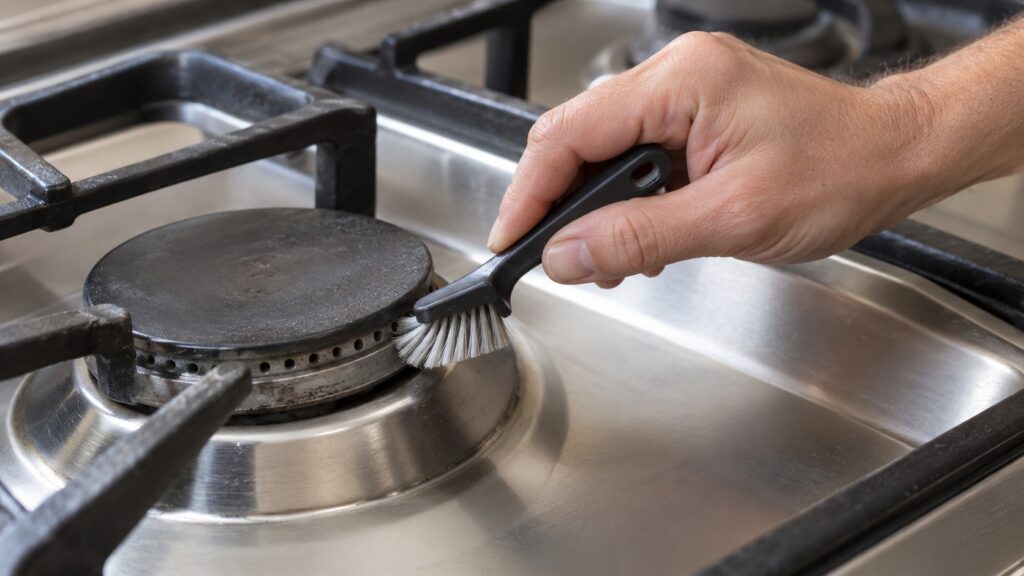
How do you clean the burner caps and heads step by step?
- Turn all the knobs to off, let the cooktop cool and make sure there is no smell of gas.
- Lift off the continuous cast iron grates and set them aside.
- Lift the cap off each burner. Caps sit on the head and are not fastened.
- Wash the caps in warm soapy water, rinse and dry them completely.
- Brush the ports around the burner head with a soft brush, working along the ring. Clear any blocked port gently with a straightened paper clip.
- Wipe around the burner base with a damp cloth. Do not let water run into the burner opening.
- Let every part dry fully before you reassemble, because a damp burner will not light well.
- Set each cap back so that it sits flat and centered. A cap that sits even slightly proud gives an uneven flame.
How do you care for the PowerBurner and the simmer ports?
The high-output burner on these cooktops is called the PowerBurner. On the JGC3536GS and JGC3215GS it is described as dual-stacked, and on the Euro-Style JGC7530BS and JGC7636BS as brass. Our power burner guide explains that on a dual-stacked burner the low setting uses the small inner ring of ports, which is why a clogged inner ring is the first reason a burner will not hold a simmer. When you brush the burner, spend the most time on that inner ring and on the ports that face the electrode. Wipe brass caps with a soft cloth rather than a scouring pad.
How do you clean around the igniter?
Next to each burner is a small ceramic igniter. Our model pages list single point electronic ignition on several of these cooktops. A film of grease or a drop of dried food on the igniter can stop a spark from reaching the gas, which shows up as a burner that clicks but does not always light. With the cooktop cold, wipe the igniter tip very gently with a dry cotton swab or a dry soft cloth. Do not bend it, do not pull it and do not use water or cleaner near it. If residue will not come off, leave it for a technician. If the burner lights unevenly on a clean, dry, correctly seated cap, the cause may be the igniter itself or the spark module, which a technician should check.
When is cleaning not enough?
Call a technician if a burner still will not light after cleaning, sparks but does not always ignite, has a yellow or lifting flame on a clean head, or keeps clicking after it has lit. Do not attempt to adjust gas valves, orifices or connections yourself, and do not buy a repair kit and fit one on a gas line. If you smell gas at any time, do not use switches or flames, leave the house, and call your gas utility or 911 from outside. Our guide to a cooktop burner that will not ignite lists the safe checks, and our Jenn-Air cooktop repair page describes the visit. We are an independent repair company, not a factory service arm. If the cooktop is old, see cooktop repair or replace. You can also book a visit.