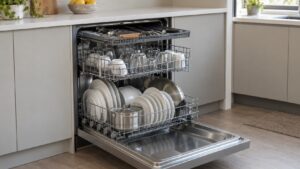
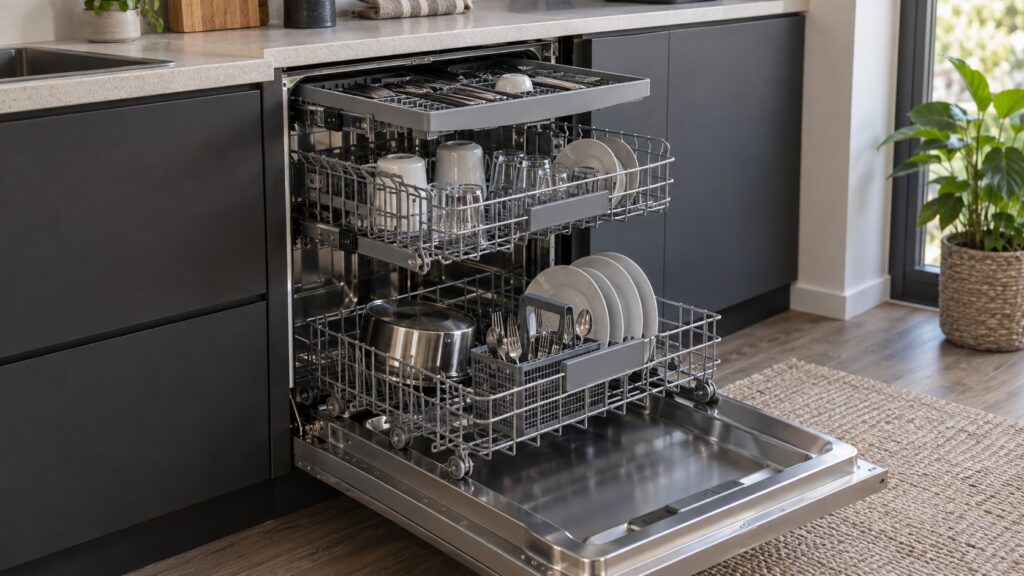
Jenn-Air TriFecta wash is the name for the dishwasher’s three-level wash system: one pump feeding three separate water paths so that the shallow top rack, the upper rack and the lower rack each receive their own supply instead of sharing whatever splashes upward. That single design choice explains most of what owners notice about these machines — why they are quiet, why leveling matters more than on an older dishwasher, and why a complaint about one rack almost never turns out to be a failed pump.
What is TriFecta wash on a Jenn-Air dishwasher?
It is a water distribution system, not a wash program. There is no TriFecta button on the panel. The name describes how the machine’s single circulation pump splits its output three ways, through a feed tube that climbs the rear wall of the tub and delivers water to jets at each level.
The distinction matters because of what people expect from it. TriFecta does not add cleaning power in the sense of pressure or temperature — those are set by the program you choose. What it adds is coverage. In an older two-level dishwasher, the top of the tub is washed by whatever the upper arm throws up there, which is why flat items laid across the top of the upper rack came out streaked. A dedicated third-level supply removes that compromise.
The name appears in our glossary of Jenn-Air feature names alongside the other capability names in the line, which is worth a look if you are trying to work out which of the words on a spec sheet describe hardware and which describe finishes.
How does the water reach all three levels?
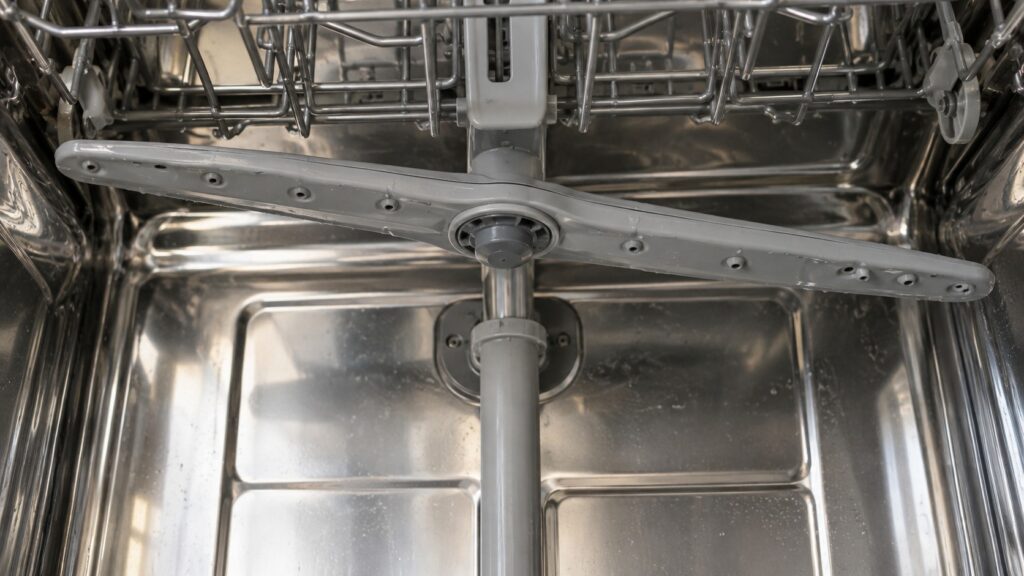
Water leaves the pump under the tub floor and immediately divides. Part of it goes straight to the lower spray arm, which carries the largest share because the lower rack holds the dirtiest load. The rest climbs the feed tube at the back of the tub. Partway up, the tube couples to the upper spray arm through a fitting that engages when the rack is pushed fully home. The remainder continues to the top, where a set of fixed or slowly rotating jets covers the shallow tray.
Two consequences follow from that geometry, and they are behind most of the service calls we see on these machines.
First, the racks are part of the plumbing. An upper rack not pushed all the way in does not connect to its supply, so the upper level runs dry while the lower rack washes normally. Second, the supply is shared and sequential. Anything that reduces total flow — a partly blocked filter, a low fill, a restricted inlet — shows up at the top of the tub first, because the highest jets are the hardest for the pump to reach.
Why does leveling matter on a three-level machine?
Water has to reach three heights on the same pump pressure, so the tub has very little margin for tilt. A dishwasher sitting even slightly low at the back or twisted in its opening changes how much water pools at the sump and how evenly each arm loads. The usual symptom is a machine that cleans the lower rack perfectly and leaves a haze on the third level.
Leveling on a built-in is also not a one-time event. A cabinet run settles, a new floor gets laid over the old one, and the mounting brackets that hold the dishwasher to the counter can loosen over years of door cycles. If the cleaning quality of a machine has slowly changed without any code or noise appearing, check whether it still sits square before assuming a part has aged.
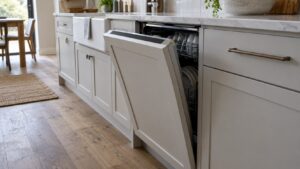
Panel-ready models add one more variable: a custom door panel adds weight to the door, and a door that does not close square can leave the tub under slight strain. Any panel swap is worth following with a check that the door still closes with even pressure along the seal.
Why is one bad rack not a pump problem?
Because the pump serves all three levels from one outlet. If the pump were weak or failing, every level would suffer at once and the machine would usually be noisy about it. A single level washing badly points instead at what is unique to that level: its own jets, its own arm and its own connection.
Work through it in this order. Spin each spray arm by hand and confirm it turns freely — a chip of glass or a fruit label under an arm will stop it. Hold each arm up to the light and look through the jets for mineral blockage, which is common in hard-water areas and shows up as a few holes that will not pass a toothpick. Confirm the upper rack seats fully. Then look at loading: a sheet pan standing upright in the lower rack blocks the upward path to everything above it, and a tall pot inverted over the upper arm stops it turning.
Only when all three levels wash poorly at once is the shared side — the pump, the filter, the fill — worth suspecting.
How should I load a three-level rack system?
The principle is that each level should let water past, not just receive it.
- Third level: flat and low items only, laid so nothing stands proud into the roof of the tub. Long utensils belong here rather than in a basket.
- Upper rack: glasses and cups angled face down and inward. Nothing tall enough to foul the third level above or the arm below.
- Lower rack: plates facing the center, large pans at the sides rather than across the front where they block the upward path.
- Never: a cutting board or a sheet pan laid flat, or anything that forms a roof over a spray arm.
Routine care for the shared parts is covered in our dishwasher maintenance guide, and the filter stack is the item that repays attention most.
Which faults look like a wash-system problem but are not?
Three regularly get blamed on the wash system. A cycle that stalls and posts a code is a timing or step failure rather than a distribution one — the FAE5 cycle completion code is the usual example. Cloudy glassware that wipes clean is water hardness, not coverage. And a machine that will not drain leaves soil behind on everything, which looks like a wash failure but is covered by the drain side entirely.
When is it worth a service visit?
Book when all three levels wash poorly at once, when an arm will not turn after cleaning, when the feed tube connection leaks into the tub floor, or when a code accompanies the complaint. Bring the model number from the tub rim and note which levels are affected — on a three-level machine that one detail narrows the diagnosis more than anything else you can tell us.
We are an independent repair company, not a factory service arm, and on a panel-ready built-in we handle the custom door panel as part of the job. Pricing starts from a diagnostic visit and we confirm the estimate before any work begins. Jenn-Air dishwasher repair covers the pump, the feed tube and the spray arms described here, and you can schedule a visit when you have checked the arms and the seating.